The Future Is Uncertain. UNITAR Made It a Game.
How an energy policy simulation at UNITAR’s conference in Brussels made me question whether we can really tell a good decision from a bad one.
Imagine being responsible for the electricity supply of an entire country. Demand is rising, the budget is tight, and climate commitments still have to be met. You choose a strategy, calculate the risks — and lose.
Then you discover that your decision was perfectly reasonable. You were simply unlucky.
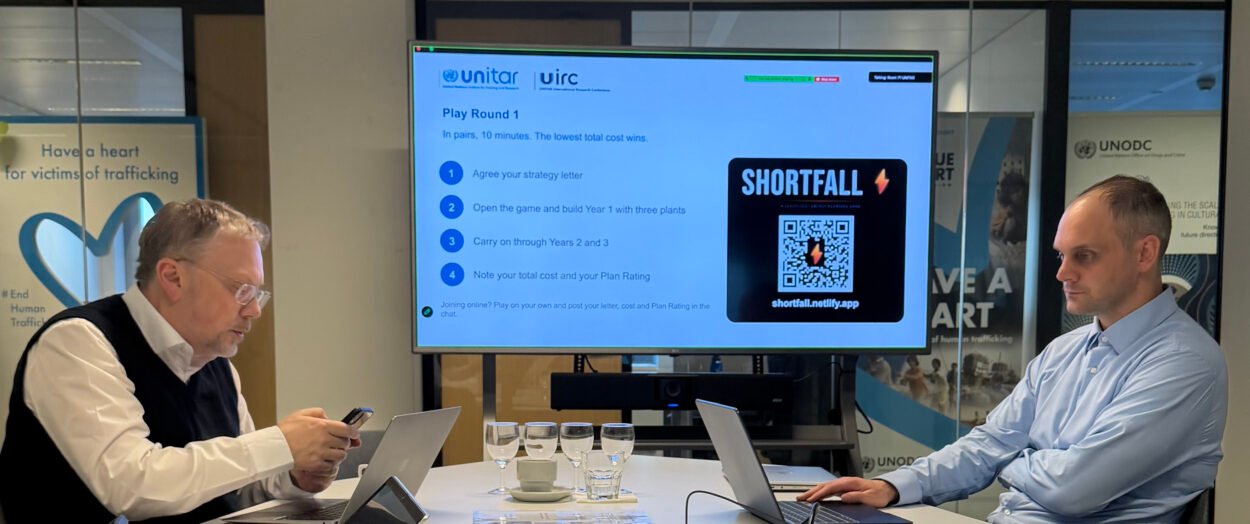
This was the trap Dr Leigh Martindale of Loughborough University set for participants at UNITAR’s Educating for Futures conference. His workshop, Shortfall, held on 18 November at UN House in Brussels, looked like a game about energy policy. In fact, it was an experiment in how much faith we place in our own judgement.
Players had coal, gas, nuclear power, solar, wind and hydropower at their disposal. Electricity demand kept climbing, and so did the stakes. Renewables were cleaner but not always predictable. Fossil fuels offered certain advantages in reliability, but came with the risk of additional carbon penalties. And while you were busy making plans, an imaginary COP31 summit could change the rules.
Nothing personal. Just politics.
Martindale presented a strategy with an expected cost of 111 units. After a series of unfavourable events, the actual cost rose to 145. A failure, surely. But was the strategy itself wrong?
We have a habit of judging decisions with the benefit of hindsight. The winner is hailed as a genius; the loser dismissed as incompetent. Yet luck has a remarkable talent for disguising itself as skill, just as misfortune can look suspiciously like stupidity.
To demonstrate this, Martindale compared five strategies, running each through the simulation a thousand times. The result was even more revealing: the winner changed depending on the criteria. Lowest cost? Fewer emissions? Protection against the worst-case scenario? First, you have to decide what success actually means.
But who decides the rules in the first place?
One participant suggested incorporating national energy policies into the simulation. If a country is firmly opposed to nuclear power, no amount of mathematical advantage will persuade it to build a reactor tomorrow. A computer model may be perfectly logical. Real-world politics rarely is.
Another question concerned students without a strong mathematical background. Martindale observed that the real difficulty often lies not in the equations, but in learning a different way of thinking.
I particularly liked that point.
Education tends to train us to look for the right answer. Yet in life, the most important decisions often have to be made before that answer is known. Governments build power stations without knowing future energy prices. Cities prepare for climate threats without knowing exactly how events will unfold.
Earlier that day, I had watched researchers turn academic papers into virtual worlds. Here, the approach was different: rather than simply exploring a complex system, we were invited to make decisions within it — and confront the consequences of our own assumptions.
There is a particular appeal to this. In a simulation, you can get things wrong without plunging a country into darkness. Instead, you learn to question convincing forecasts, examine hidden assumptions and resist confusing an outcome with the quality of the decision behind it.
By the end of the workshop, I was less interested in which strategy had won. What intrigued me far more was why we had decided that particular strategy deserved to win.
Perhaps that is one of the most valuable lessons education can offer us about the future.
Not every defeat means you made a mistake. And not every victory proves you were right.