The Promise and Paradox of Virtual Education
At UNITAR’s Educating for Futures conference in Brussels, a virtual journey through Kuwait’s water crisis revealed how immersive technologies could reshape education — and the barriers that still stand in the way.
What if you could walk through a research paper?
Imagine entering a virtual Kuwait, where a journey from an oil-powered desalination plant to a hospital reveals an unexpected chain of connections. Water depends on energy. Healthcare depends on both. And pressures from climate change, population growth and migration ripple through the entire system.
Rather than explaining these relationships through charts alone, researchers have turned them into a landscape that visitors can explore.
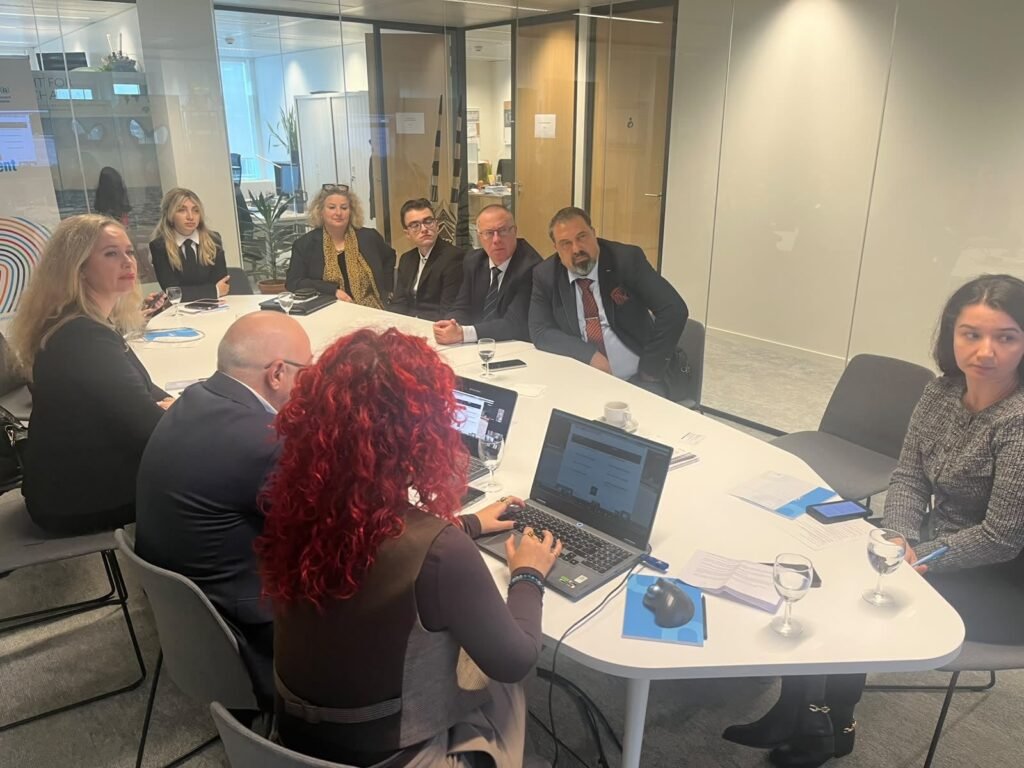
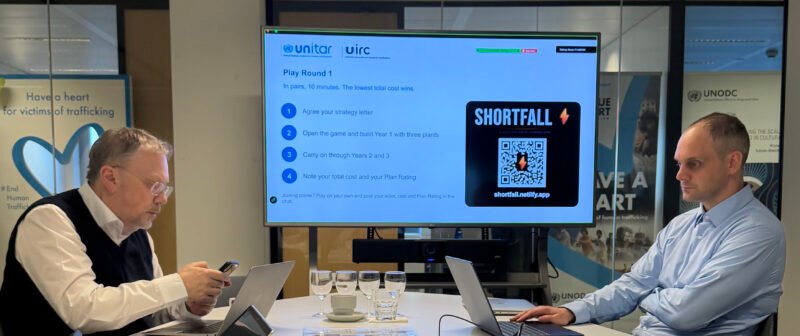
The project was presented at the fourth UNITAR International Research Conference, Educating for Futures, held at UN House in Brussels on 18–19 November 2026. During a panel titled Immersive Futures, academics and researchers from Çağ University in Türkiye and Technological University Dublin in Ireland demonstrated how virtual environments can bring complex ideas closer to the people learning about them.
Behind the avatars and digital landscapes lay a larger question: can technology change not only how we access knowledge, but how we understand and use it?
When Research Becomes a Place
At the heart of the presentation was the work of Dr Abrar Alzankawi of Technological University Dublin, whose research examines the relationship between water scarcity, oil dependence, migration and public health in Kuwait.
For a country without permanent rivers or lakes, freshwater security presents a particular challenge. Kuwait relies heavily on desalination, an energy-intensive process closely linked to its oil-dependent economy. The consequences extend far beyond water supply, touching public services, economic resilience and national security.
To make these connections easier to explore, Alzankawi and her collaborators developed an immersive expedition in Second Life.
Visitors navigate three interconnected zones through their avatars. One explores the relationship between oil and desalination; another illustrates the pressures of migration and population growth; the third leads to a virtual health centre, where the importance of reliable water supplies becomes immediately apparent.
Along the way, interactive displays, narrated explanations and short quizzes encourage visitors to investigate rather than simply observe.
“What if a thesis could become a place that people can walk through rather than a report they can read?” Alzankawi asked.
It is an appealing proposition: instead of encountering sustainability as a collection of separate problems, learners can explore the relationships between them.
The expedition is still an evolving educational project, with independent learner evaluation planned as a next step. Its significance, for now, lies in demonstrating how academic research might reach audiences beyond the university.
From Student to Creator
For Çağla Solak, immersive learning has already opened doors beyond the classroom.
Now a VR laboratory assistant at Çağ University, Solak recalled taking two courses on virtual reality and the metaverse taught by Professor Murat Gülmez. Her interest in gaming and technology developed into practical 3D-modelling skills, eventually leading to her current role creating virtual learning environments.
The courses also introduced her to international collaborators, including John O’Connor of Technological University Dublin. Today, while pursuing an MBA, she contributes to projects alongside researchers and educators from different disciplines and countries.
Solak’s journey shows how an interest sparked in the classroom can grow into a career, opening doors to international collaboration and new opportunities along the way. Her experience also reflects a broader ambition behind these projects: to make learning a bridge between people, disciplines and countries.
A Classroom Without Borders
The panel offered other examples of what happens when learning moves into shared virtual spaces.
John O’Connor described an international student challenge organised through the Virtual Worlds Education Consortium. Unlike a traditional hackathon, the competition unfolds over an academic semester, giving teams time to develop projects with support from mentors and educators.
Students from different countries can work together, exchange ideas and see how their peers approach similar challenges.
The team also showcased a virtual replica of the United Nations Security Council chamber, which they hope to use for Model United Nations-style simulations involving participants from around the world.
These initiatives suggest that immersive environments can offer more than a digital substitute for physical classrooms. They can create spaces for collaboration, experimentation and encounters that might otherwise require international travel.
Yet removing geographical distance does not automatically remove every barrier.
Who Gets to Enter?
Yet the promise of a borderless classroom raises a fundamental question: who truly has access to it?
When asked about accessibility in developing countries, Professor Gülmez acknowledged a significant barrier: immersive environments often require powerful computers, placing them beyond the reach of many learners. To address this, his team is exploring more accessible alternatives, including asynchronous video content, alongside digital badges and micro-credentials that recognise skills acquired through flexible learning pathways.
The challenge, then, is not simply to connect learners across continents, but to ensure that the opportunities created by these technologies are not limited to those with the resources to access them.
Ultimately, the promise of immersive learning lies not in the virtual worlds we can build, but in the possibilities they can unlock for others. As the boundaries of the classroom begin to fade, education has an opportunity to become more than preparation for an uncertain future — a space where learners discover not only what tomorrow might hold, but how they can help shape it.