From Batteries to Big Oil: Five Oxford Researchers Put AI to Work
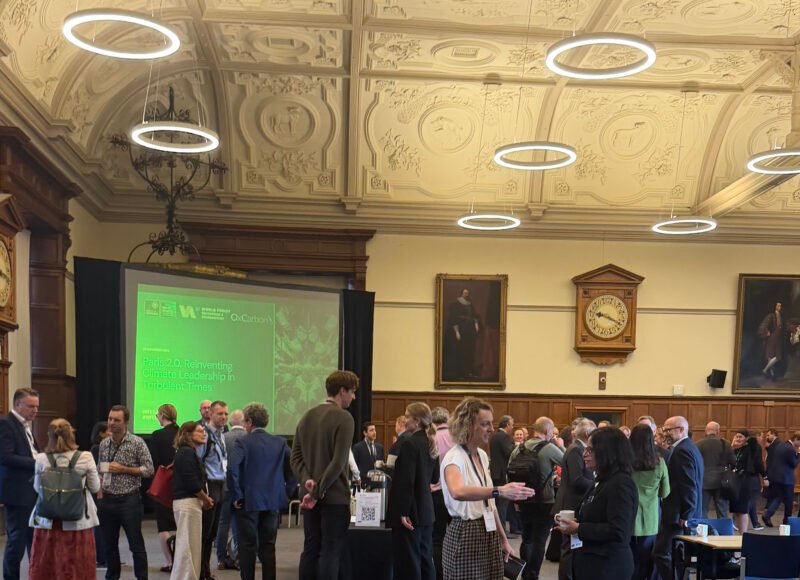
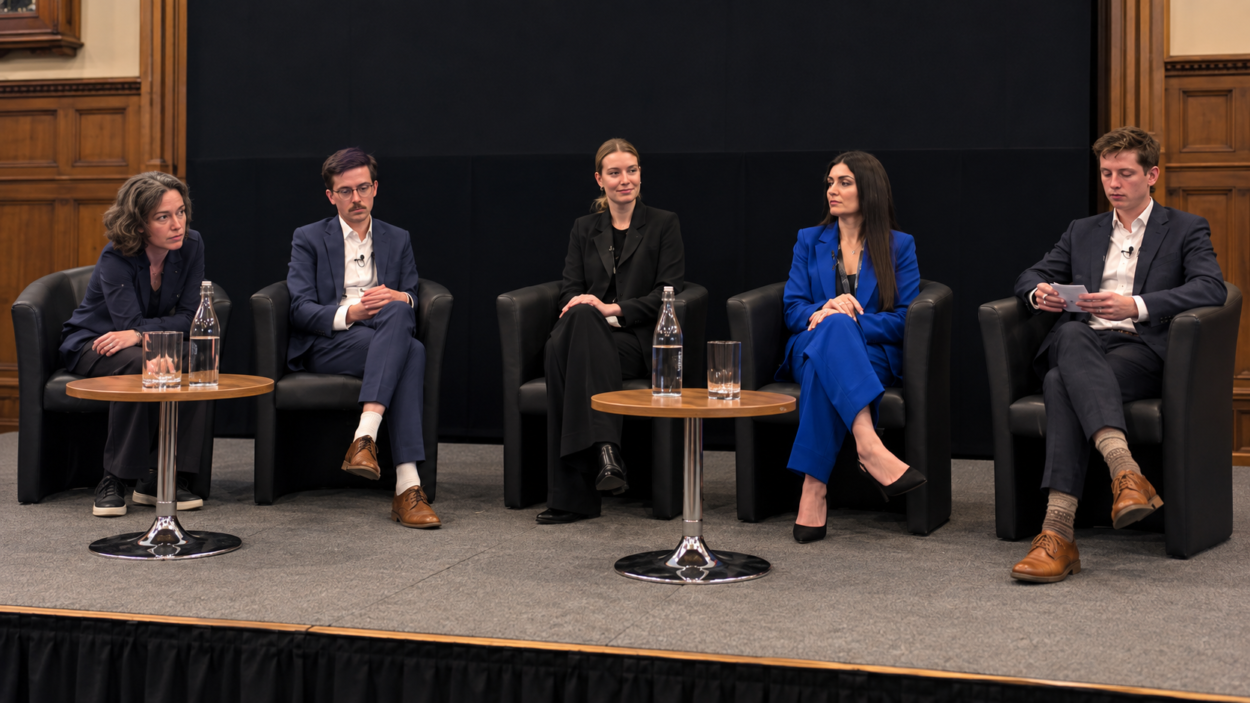
At the University of Oxford’s Smith School of Enterprise and the Environment, five researchers demonstrated how artificial intelligence can help us understand technological progress, evaluate conservation projects, identify dangerous dumpsites, map industrial assets and search corporate archives. The session was hosted by Nadia Schroeder, the Smith School’s Head of Strategy and New Initiatives.
Artificial intelligence has lately been asked to write our emails, plan our holidays and produce pictures of cats dressed as Tudor monarchs. At Oxford’s Smith School of Enterprise and the Environment, it has been given rather more consequential work.
Hosted by Nadia Schroeder, the session brought together five researchers applying AI to some decidedly real world problems. Their subjects ranged from two centuries of battery development to climate litigation against fossil fuel companies. What connected them was a refreshingly practical question: can AI help us find better evidence and make better decisions?
Amir Akther: learning from 200 years of batteries
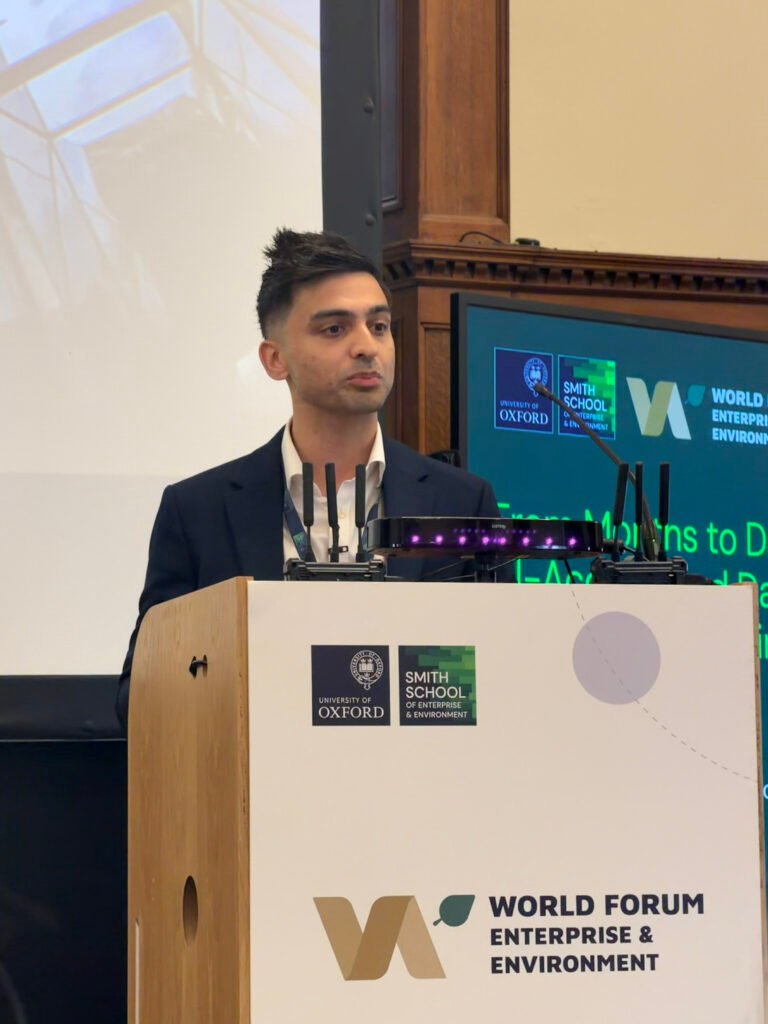
Amir Akther opened with a journey through the history of battery technology.
His presentation traced the development of batteries from the early nineteenth century to the arrival of the commercial lithium ion battery in 1991. A component that once represented hundreds of hours of human labour can now be produced in seconds.
The point was larger than batteries. Long historical datasets allow researchers to compare technologies across countries and periods, revealing how costs fall, performance improves and innovations spread.
AI can make it possible to analyse more technologies over longer periods, giving researchers a much richer view of technological change.
“It allows us to look at more technologies, more countries and much longer histories. That allows us to ask bigger questions and, hopefully, get better answers,” Akther said.
For the energy transition, this matters. Understanding how quickly technologies improve can help policymakers and investors judge which innovations are approaching a commercial breakthrough and which may still require support.
Tanya O’Garra: did the project actually work?
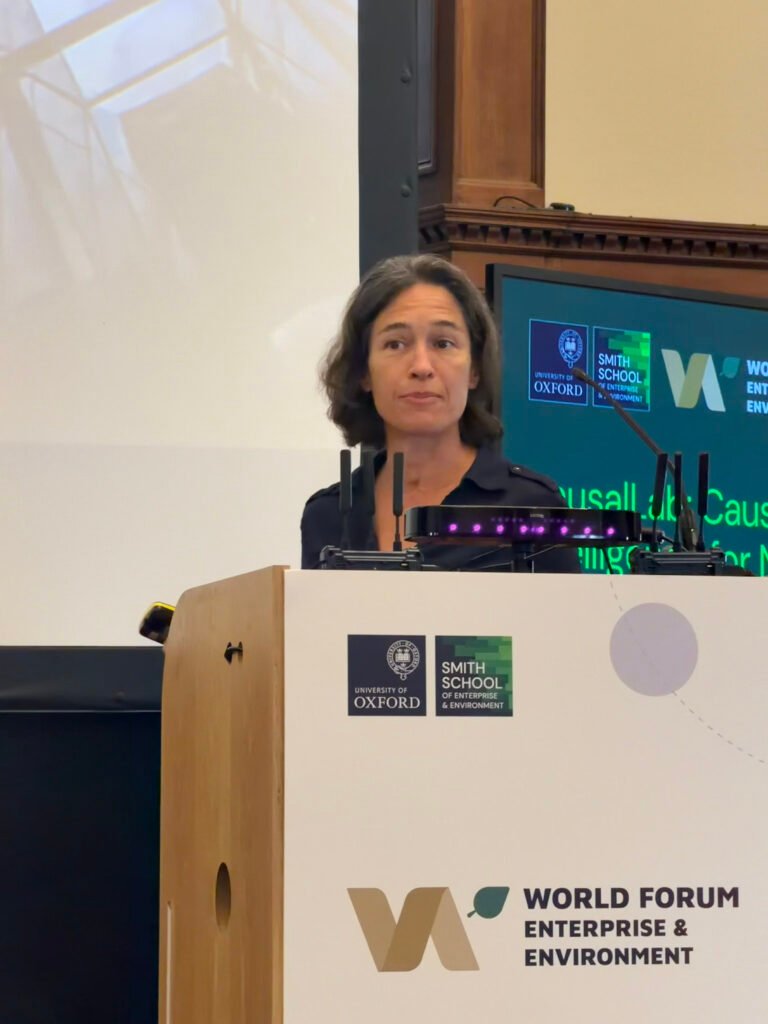
Environmental programmes are generally good at recording what changed. A forest may have gained tree cover, a species may have returned or local incomes may have risen.
But Dr Tanya O’Garra warned that observing a change does not tell us what caused it.
“Monitoring change is not the same as evaluating impact. What we really want to know is the extent to which our investments, projects and programmes contributed to the change we observed,” she said.
O’Garra presented a prototype that combines artificial intelligence with causal inference: the methods researchers use to determine whether an intervention genuinely produced a particular result.
The system tests different models, changes variables, resamples the data and attempts to break its own conclusions. In a simulated example, simply measuring the change would have exaggerated the impact of a conservation programme by almost three times.
That is more than a statistical inconvenience. If governments or funders scale up a project on the basis of an inflated result, they may spend substantial sums on an intervention that does not work as well as expected.
The ambition is to combine AI, causal reasoning and Earth observation data to understand how environmental interventions affect different places and social groups. In plain English: to establish what works, where it works and for whom.
Amani Maalouf: mapping the places the world would rather overlook
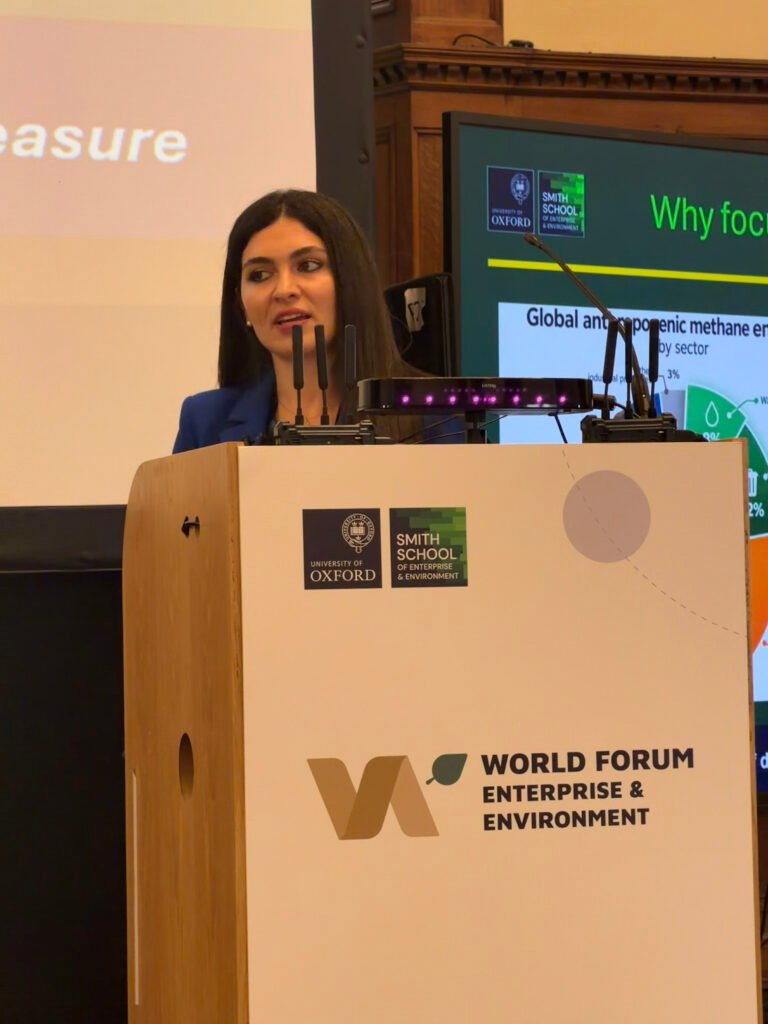
The next presentation moved from conservation projects to one of the less photogenic parts of the global economy: rubbish.
Dr Amani Maalouf explained that waste is the third largest source of methane emissions, yet reliable information about dumpsites remains remarkably scarce. In many developing countries, organic waste is deposited at uncontrolled sites, frequently alongside open burning.
The consequences extend far beyond unpleasant views and smells. Dumpsites can contaminate groundwater, release toxic fumes and expose nearby communities and informal workers to serious health risks.
“We cannot manage what we cannot measure,” Maalouf said.
Her team’s answer is GeoWaste, a database combining artificial intelligence, satellite imagery and geospatial analysis. The researchers initially identified more than 5,000 potential dumpsites, narrowed these down to locations with sufficient evidence and then characterised 200 major active sites.
The database records where the sites are, who operates them, how much waste they receive, their potential methane emissions and their proximity to communities. It also considers the position of informal workers, many of whom are women, children and members of particularly vulnerable groups.
The aim is not simply to create an alarming map. The data can help governments and financial institutions identify where intervention is most urgent and act before a site becomes still more dangerous.
Christophe Christiaen: connecting finance with physical reality
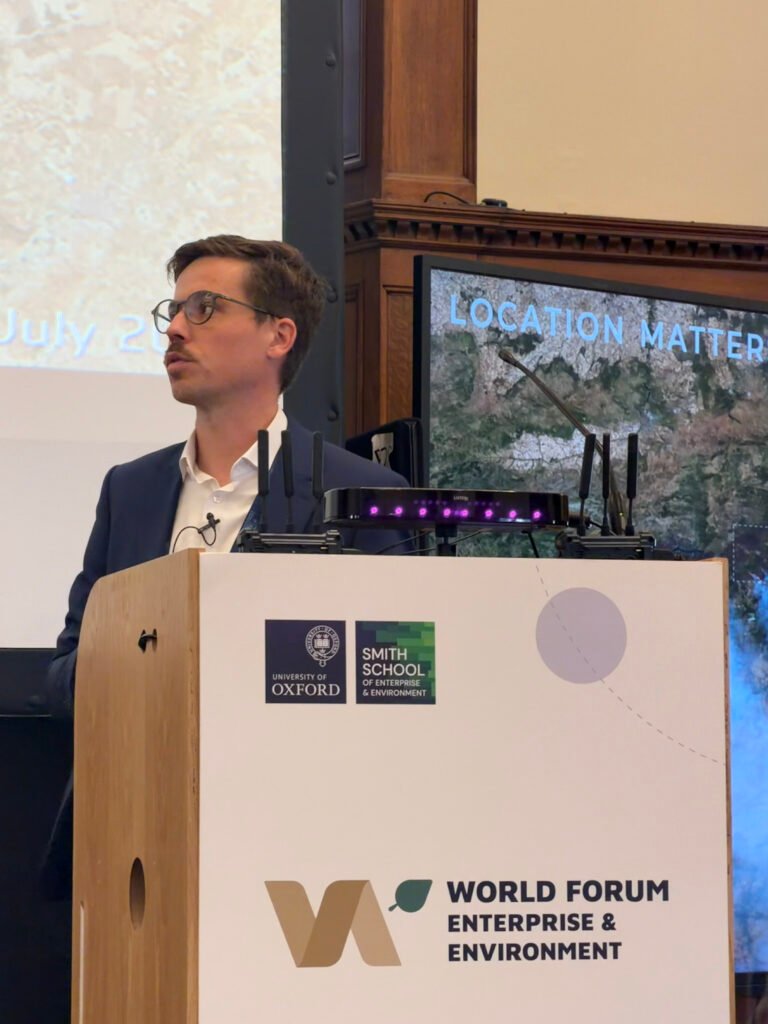
Christophe Christiaen picked up the geospatial thread and followed it into the financial sector.
Investors may own shares in a company without having a clear picture of the mines, factories, cement plants or other physical assets behind it. Yet those locations are precisely where many environmental risks become tangible.
The GeoAsset project creates open databases showing the location, ownership, capacity and other characteristics of assets in industries with a significant environmental impact.
Collecting this information has traditionally been slow and decidedly unglamorous. Researchers built individual pipelines to extract ownership information from text, locate facilities in satellite images and identify their operating characteristics. Each model had to be trained, tested and adapted to a particular industry.
Large language models are beginning to change that process.
“What is really exciting today is that we are finally seeing AI tools that are speeding up this process tremendously,” Christiaen said.
A researcher can now ask a question in ordinary language, such as identifying Britain’s largest cement plant and examining how its physical footprint has changed over the past decade. The system can search different sources, process geospatial information and return an accessible answer.
This gives financial institutions a clearer view of what they are actually financing. A portfolio may look reassuringly abstract on a spreadsheet; its environmental consequences are rather less abstract on a satellite image.
Benjamin Franta: finding needles in corporate haystacks
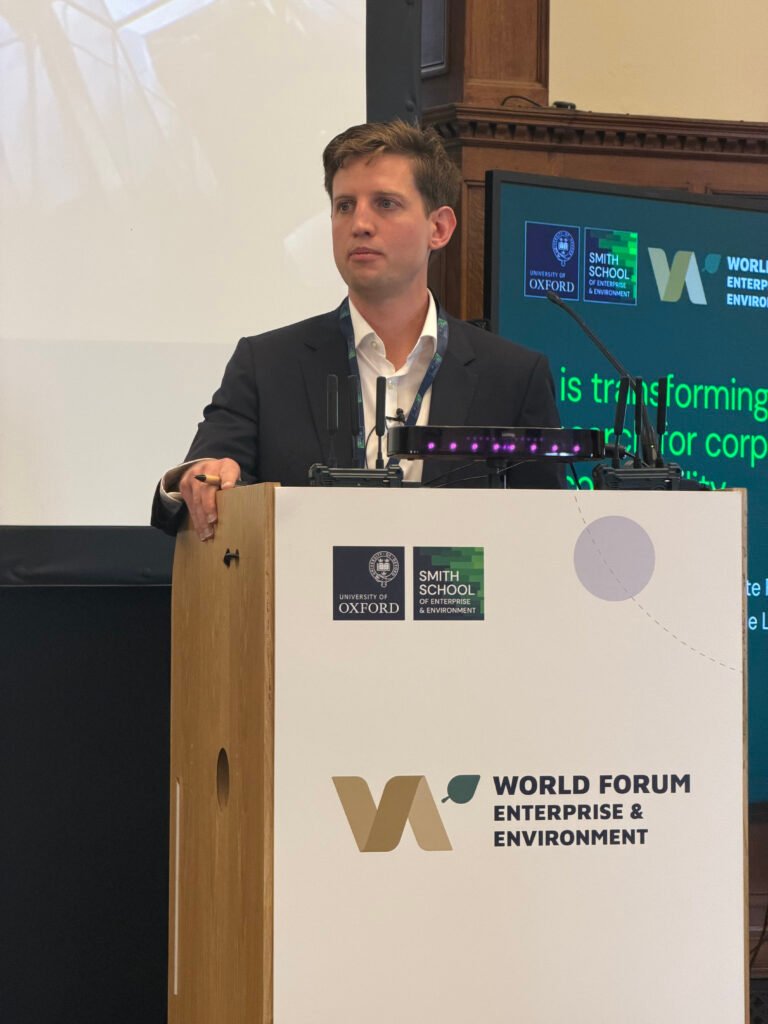
The final speaker, Dr Benjamin Franta, turned to evidence buried in corporate archives.
Franta is an Associate Professor of Climate Litigation and leads the Climate Litigation Lab at Oxford’s Sustainable Law Programme, which sits within the Smith School. His team has developed CLARA, the Corporate Litigation and Accountability Research Assistant.
Litigation involving tobacco, fossil fuels and other industries has released millions of pages of internal documents. These archives may contain evidence of what companies knew, when they knew it and how they responded. Their sheer size, however, makes comprehensive human review nearly impossible.
CLARA uses retrieval augmented generation to search these collections. It answers questions, cites the evidence behind each statement and links users to the original documents.
Franta demonstrated this by asking for the earliest evidence of Exxon’s awareness of global warming. CLARA identified a 1978 memorandum referring to a presentation delivered to the company’s board the previous year. The system therefore returned 1977, while showing users exactly how it reached that conclusion.
“We want to trust and verify. We can go back to the original document and see what it says for ourselves,” Franta explained.
That final step is essential. AI may locate the evidence, but a human researcher must still read the source, understand its context and decide what it proves.
Speaking after his presentation, Franta reflected on documents showing that fossil fuel companies had considered different climate futures decades ago. Internal Shell scenarios from the 1980s examined the consequences of continued fossil fuel consumption and anticipated effects including flooding, conflict and population displacement.
“What we are seeing today was not inevitable. There was another choice, and these companies understood that a long time ago,” he said.
Useful AI begins with better evidence
The five presentations covered strikingly different territory, but arrived at a similar conclusion.
AI can help researchers process datasets too large for conventional analysis. It can compare centuries of technological development, test whether environmental programmes caused the changes attributed to them, locate poorly documented dumpsites, connect investments with physical assets and search millions of pages of corporate records.
But none of the speakers treated AI as an oracle. Its value rests on transparent methods, reliable data and results that people can inspect.
The most promising role for AI may therefore be a fairly modest sounding one: helping experts find the right evidence more quickly. In a world full of confident claims and limited attention, that is quite a useful job.