The WTO Between Stability and Speed: Insights from the 2026 Public Forum
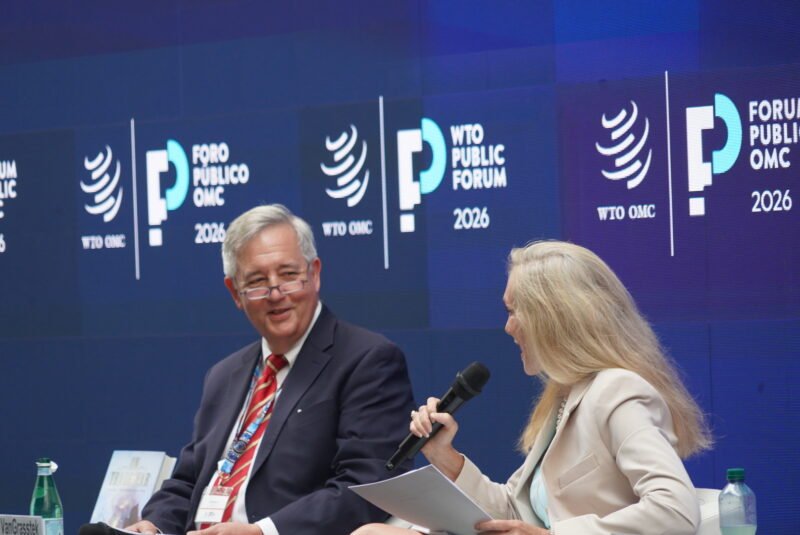
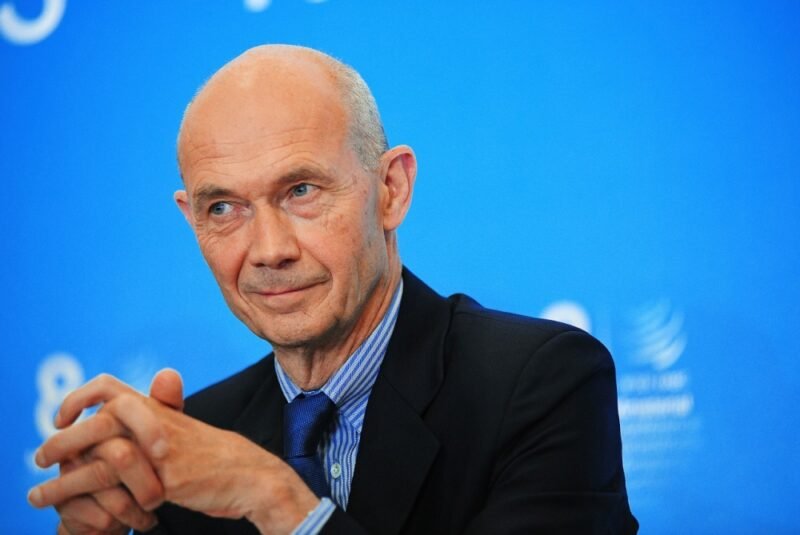
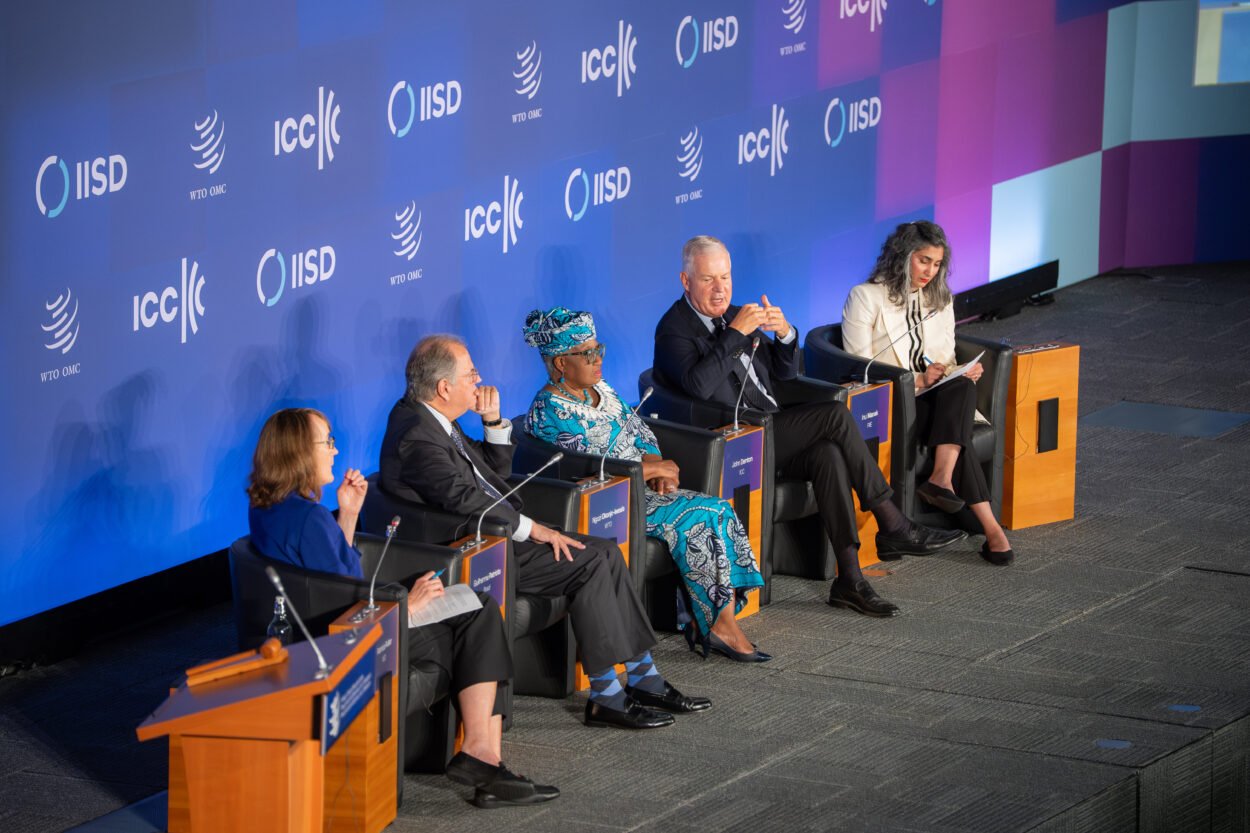
Almost a year ago, at the Paris Peace Forum, I interviewed Pascal Lamy, the former Director-General of the World Trade Organization. Our conversation centred on a question that has only become more pressing since: how does international cooperation evolve when many of the problems it is expected to address have long since moved beyond the reach of individual states? According to Lamy, traditional international mechanisms do not always move at the pace contemporary challenges require. New coalitions can form around a particular objective, bringing together the actors best placed to address it and operating at a different rhythm from classical diplomacy. Almost a year later, I found myself returning to that conversation in Geneva, during the opening panel of the WTO Public Forum 2026.
The vocabulary was somewhat different. Here, the discussion focused primarily on WTO reform and on whether groups of members should be able to advance particular initiatives within the wider multilateral system. Yet beneath the terminology was a remarkably similar question: what happens to an international institution when the world around it begins to change faster than the institution itself?
That, perhaps, was where the central dilemma of the Forum first became clear: how can the stability of common international rules be reconciled with the speed at which the global economy is now evolving?
Ambassador and Deputy Permanent Representative of Brazil to the UN, Guilherme Patriota framed the problem in practical terms. Global trade is moving from an economy traditionally understood through goods towards one increasingly shaped by services, digitally delivered services and, now, artificial intelligence. The obvious question is whether rules negotiated decades ago still correspond to the economy they are expected to govern.
Patriota’s argument pointed to a problem at the heart of the WTO: its rules were built for an economy that no longer quite exists. They still provide order and predictability, but digital trade, services and AI are steadily testing the categories on which that order was built. The question is how far the system can bend without losing the stability that gives it value.
Sitting in the room, I realised that almost a year earlier I had understood this debate mainly as a question of institutional architecture. In Geneva, it felt considerably less theoretical. If the discussion in Paris had been about who else should participate in global governance, the question here was different: how must decision-making itself evolve when the participants in the system are no longer able to move at the same speed?
From the perspective of business, the problem becomes more immediate still.
As John Denton, Secretary-General of the International Chamber of Commerce, said:
“The private sector will adapt.”
Companies cannot suspend their decisions while institutional reform runs its course. They are already restructuring supply chains, reconsidering where they operate and adjusting to a more difficult geopolitical environment. Such adaptation may be more expensive and less efficient, but it will take place nonetheless.
The cost of uncertainty is not merely theoretical. Denton pointed to ICC research estimating that uncertainty in global trade over the past two years has resulted in nearly $600 billion in lost business opportunities. Against that background, his warning that the private sector will adapt sounded less like a prediction than a description of a process already under way.
That leads to a far less comfortable question for the WTO itself. If the organisation spends too long discussing reform without translating it into practical change, Denton suggested, it risks gradually making itself irrelevant.
This may be one of the most important observations to emerge from the opening discussion. The principal threat to the WTO is not that international trade would suddenly cease in its absence. Quite the opposite. Trade would continue. Companies would adapt. Governments would construct new arrangements, regional mechanisms and coalitions.
The more consequential question is whether the WTO will remain the place in which the rules governing that trade acquire a genuinely common character.
Yet it would be equally misleading to describe the organisation as a relic of an earlier age. Dr Ngozi Okonjo-Iweala, Director-General of the WTO, has pointed to evidence in the WTO’s 2026 World Trade Report showing that around 72 per cent of global merchandise trade still takes place on WTO most-favoured-nation terms. Despite trade disputes, geopolitical rivalry and repeated predictions of fragmentation, a substantial share of global commerce therefore continues to rely on the foundations of the multilateral trading system.
“It is not government officials that trade. It’s businesses,” she observed.
And businesses continue to value one of the system’s most important qualities: predictability.
The WTO, then, has not simply become obsolete. It has reached the limits of an architecture designed for a different economic era. Its foundations continue to function, but a growing number of economic activities fit increasingly awkwardly within the categories on which that architecture was built.
Services offer a particularly clear example. Okonjo-Iweala noted that trade in services is already growing considerably faster than trade in goods. The WTO expects services trade volumes to expand by 4.8 per cent in 2026, significantly outpacing goods trade.
More interesting, however, is the extent to which the distinction between a good and a service is itself becoming less obvious.
Okonjo-Iweala used the example of a modern refrigerator. Formally, it remains a physical product. Yet it can now analyse its contents, assess the condition of food and provide information and recommendations to its owner.
“Goods are increasingly, with AI, having services embedded in them.”
A product that once belonged unambiguously to the category of goods increasingly functions as a vehicle for digital services as well.
The example is deliberately ordinary, but the regulatory implications are not. International trade rules have historically relied heavily on distinctions between goods and services. As those boundaries become less clear, the logic of regulation built around them inevitably comes under pressure.
For developing economies, the shift towards digitally delivered services carries another implication. Participation in international trade no longer always requires the same industrial base or physical logistics associated with traditional exports. Okonjo-Iweala pointed in particular to the opportunities this may create for developing and small island economies.
The distance between economic reality and international regulation is therefore becoming more visible. During the discussion, Okonjo-Iweala described global rules for digital trade as still insufficiently developed while identifying digitally delivered services as an increasingly important part of trade’s future.
The result is a striking asymmetry: the economy of the future is already emerging, while the international architecture intended to govern it is still being constructed.
Artificial intelligence only sharpens that tension. The familiar sequence — a technology emerges, governments assess its implications and negotiations over appropriate rules follow — increasingly struggles to match reality. By the time a lengthy international process reaches its conclusion, the technology itself may already have moved on.
As Okonjo-Iweala said:
“We really have to be agile as an organisation.”
Yet agility sits uneasily beside one of multilateralism’s greatest strengths. The legitimacy and predictability of multilateral rules come precisely from the fact that they are developed collectively. Collective agreement, however, takes time — and the digital economy, particularly in the age of AI, affords remarkably little of it.
In that context, plurilateralism begins to look less like a challenge to the multilateral system than a possible means of keeping movement alive within it.
Denton used the less technical term “pathfinders”: countries willing to move forward on a particular issue without requiring the entire membership to wait for full consensus, while keeping the door open for others to join later.
Seen through the lens of my conversation with Lamy, the parallel is revealing. Polylateralism widens the range of actors involved in solving a problem; plurilateralism reduces the number of states required to advance a particular solution. Both respond, in different ways, to the same pressure: an international system in need of greater flexibility than it has traditionally allowed itself.
But there was another echo of that conversation in Geneva.
Patricia Fuller, President and CEO of the International Institute for Sustainable Development, argued that the WTO now has an opportunity to “bring more voices into the discussion”, including representatives of civil society and business.
Almost a year after my conversation with Lamy about polylateralism in Paris, the question of who gets a seat at the table had resurfaced inside the WTO itself.
Fuller widened the debate beyond speed. A more flexible system also raises a question of representation: whose interests are heard as the rules evolve? Small businesses, she noted, are often least able to absorb tariffs and administrative barriers.
Yet flexibility has a cost. It can make the system more responsive, but also more fragmented.
The same tension runs through geopolitics. Economic interdependence was long seen as a source of stability. Recent shocks have shown that the ties which create resilience can also create vulnerability.
Okonjo-Iweala offered a particularly useful distinction:
“Over dependence brings friction. Interdependence brings peace.”
Patriota added a further dimension. The weaker common international rules become, the more exposed businesses are to strategic competition between major powers.
That may explain why the purpose of the multilateral trading system looks somewhat different today from what it did twenty years ago.
Still, institutional slowness alone does not explain the WTO’s difficulties. Even a more flexible system cannot function without the confidence of its members.
Okonjo-Iweala acknowledged this directly, referring to a “trust deficit” within the organisation. Many developing countries believe that their concerns were not always adequately reflected in the past and that some earlier commitments were left undelivered. Developed economies, too, have their own frustrations with the way the system operates.
This places a fundamental constraint on reform. It is difficult to ask members to move faster when some remain unconvinced that the next process will be fairer than the last. Yet continually revisiting unresolved disputes also carries a cost.
Okonjo-Iweala captured that dilemma particularly well:
“If we spend all of our time focused on trying to litigate the past, we will miss the future.”
WTO reform, then, is about more than institutional design. Greater flexibility and faster decision-making will matter only if members still trust the system in which those changes take place.
When Pascal Lamy spoke to me in Paris almost a year ago, our conversation about polylateralism centred on who should take part in global governance when states alone are no longer enough.
In Geneva, the question had shifted from participation to pace: how can an international system act quickly enough when its members can no longer always move together?
The WTO still offers what a more fragmented trading system cannot easily replicate: common rules, predictability and a forum broad enough to accommodate competing interests. Its challenge is to adapt those strengths to an economy being reshaped by services, digital trade and AI.
If it can do that, the WTO will remain more than the institution that underpins today’s trading system. It can also help shape the rules of the one that comes next.