New Coalitions for the Planet : Pascal Lamy, former Director-General, WTO
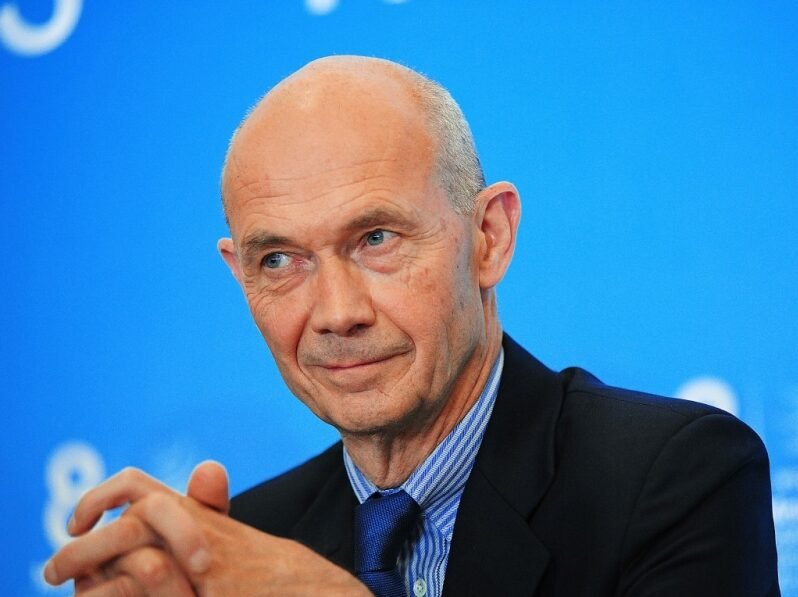
I met Pascal Lamy at the Paris Peace Forum — a place built around a question that has followed this project from the beginning: what happens when traditional institutions are no longer enough?
As former Director-General of the World Trade Organization and Vice-President of the Paris Peace Forum, Lamy has spent decades inside the architecture of international cooperation. The more interesting question was how an architecture built around states is adapting to a world in which influence increasingly lies elsewhere too.
We spoke about polylateralism, climate governance, capitalism, technology, the crisis of institutions — and about whether cooperation can still retain a human face in a more fragmented world.
AL: How can we give a human face to global governance amid rising crises and growing national egoisms?
PL: That was precisely the question we asked ourselves eight years ago when we created the Paris Peace Forum.
At the time, we had the feeling — unfortunately a justified one — that the classical mechanisms of international cooperation, meaning diplomacy between states, were running out of steam.
Meanwhile, global issues — especially environmental and climate ones — were becoming increasingly urgent. So we needed to invent something new. This new approach was to involve not only sovereign states but also other global actors: major NGOs, companies, cities, academic institutions.
The goal was to create multi-stakeholder coalitions around specific themes.
That is what the Paris Peace Forum pioneered — and it has proved successful.
Earlier this year, I co-chaired the Blue Economy and Finance Forum in Monaco, which was built on a similar model: bringing together business, NGOs, philanthropy, and science to address ocean-related challenges.
This is what I call polylateralism.
Multilateralism refers to sovereign states; plurilateralism involves some states but not all; polylateralism combines states and non-state actors.
It’s a new kind of governance — one that is purpose-led, not power-led.
AL: Thank you. As a linguist, I find this nuance fascinating.
Since the pandemic, I have tried to understand what is happening in the world. When I read Stakeholder Capitalism by Klaus Schwab, I noticed that, despite good intentions, the system remains profit-centered.
Would you say this vision is utopian, or could it one day become reality?
PL: The dominant system remains market capitalism, founded on the pursuit of profit.
Other models have been tried, but none have truly worked.
That said, we must correct the side effects of this capitalism, which generates too much inequality.
Defenders of the system often argue:
“Just change relative prices, and everything will fix itself.”
If we assign the right price to environmental externalities, behavior will change. But in truth, this is a political question — capital still outweighs labor
AL: What about technologies like blockchain? Could they help bring more transparency and trust?
PL: No technology is politically neutral.It depends entirely on whose hands hold the tool. Technology can serve the good — or the bad. It never replaces human judgment or political dialogue.
Still, in some fields like health and information, it can indeed improve human life.
AL: Let’s talk about the COPs. They are at the center of every discussion today, but many accuse them of greenwashing. What’s your opinion?
PL: The COPs are divided into two spaces: the Blue Zone — where governments negotiate — and the Green Zone, open to NGOs and other actors.
In my experience, most real innovations happen in the Green Zone.
The Paris Peace Forum can be seen as a bridge between the two — a space where political leaders, diplomats, youth, and civil society meet.
That’s where meaningful coalitions emerge, such as those focused on decarbonizing maritime transport.
AL: Speaking of maritime transport — this is also a challenge for tourism, especially in Nice and Monaco. How can sustainability coexist with economic vitality?
PL: The model of mass cruise tourism is indeed problematic. Some countries, like Australia and New Zealand, have imposed docking fees on large ships to internalize environmental costs.
It’s a market-based solution — integrating pollution, congestion, and waste into the price.
AL: We’re also witnessing a shift in global power toward Africa, Asia, and the Middle East. Is this a truly multipolar world emerging, or just a transition toward a new order?
PL: The world is certainly more multipolar today, but that doesn’t mean it’s more stable. The diffusion of power can both strengthen and weaken order.
Yet the environmental question remains our common ground — because it’s existential.
AL: I recently joined a mission to Geneva with young journalists and diplomats. At the United Nationsand the World Trade Organization, one can sense an institutional crisis — budget limits, fewer positions, declining engagement.
Do we need new forms of participation?
PL: Absolutely.
That’s what we’ve been doing for the past eight years at the Paris Peace Forum — building new, more flexible forms of cooperation that are diverse, inclusive, and results-oriented.
Our projects usually take two years to mature, live for about five, and then evolve into something else.
It’s a completely different rhythm from classical diplomacy.
AL: Thank you for this vision — and for the Paris Peace Forum itself. I’ve participated since 2021,even during the pandemic. It gave people real hope. One last question: yesterday, during your panel, you mentioned the prompt for humanity. What would it be, in your view?
PL: To reassure humanity about the future of the planet.