Sandra Nelson: The Art of Storytelling in the Age of Artificial Intelligence
From journalism to fiction, the French author has built a career on observing human nature. As artificial intelligence transforms publishing, her experience raises questions about authorship, originality and the value of human imagination.
For much of her professional life, Sandra Nelson told other people’s stories. As a journalist writing for French women’s magazines, she interviewed, observed and transformed personal experiences into compelling narratives. Today, she invents her own characters and their destinies. Yet the distinction between journalism and fiction is less pronounced than it might appear.
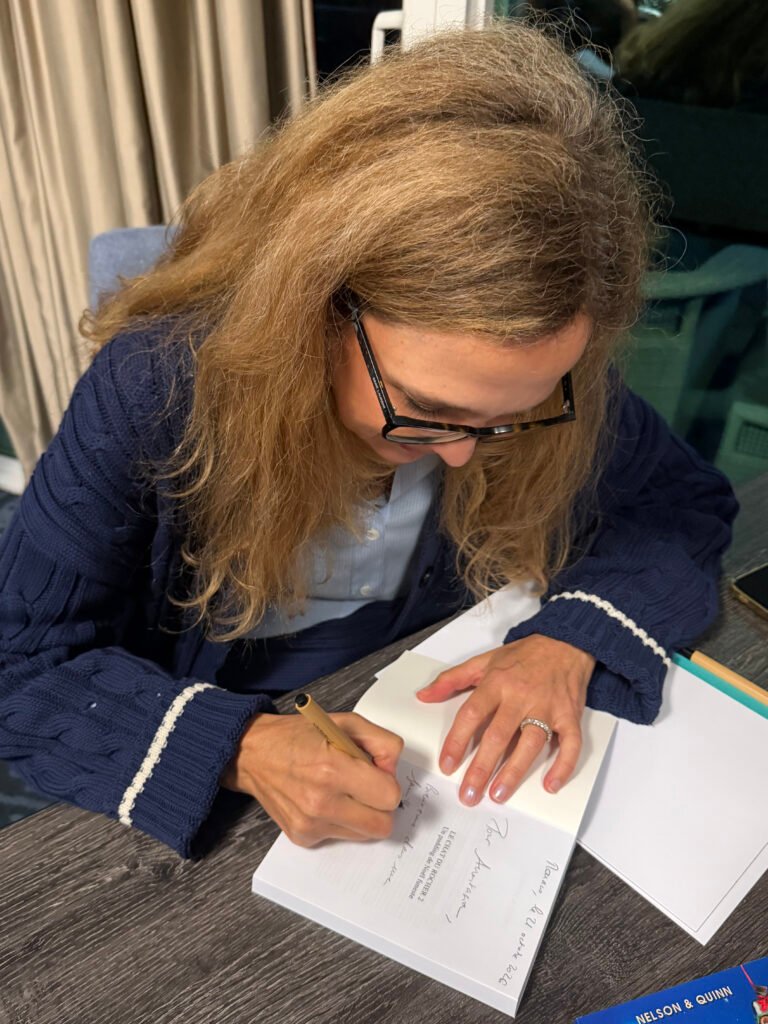
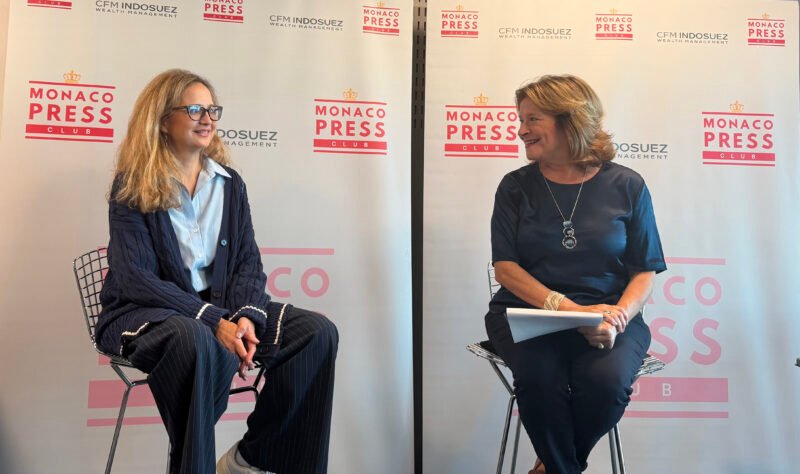
At a literary gathering hosted by the Monaco Press Club, Ms Nelson reflected on her creative journey, her collaboration with fellow author Alice Quinn and the changes reshaping publishing. What began as a conversation about books developed into a broader examination of a profession in which publication has become easier, but attracting readers’ attention increasingly difficult.
Artificial intelligence has added a new dimension to this challenge. Machines can now generate plots, reproduce literary conventions and produce manuscripts at remarkable speed. But can they replace personal experience, creative judgement and the individuality of a writer?
From journalism to fiction
Ms Nelson began her career between Paris and the French Riviera. Writing for magazines including ELLE, she developed a particular interest in women’s lives and the tensions between professional ambition, family responsibilities and social expectations.
Together with her mother, a management specialist, she wrote a study of female leadership. Among those she interviewed was Christine Lagarde. One recurring theme was the effect of motherhood on professional careers, an issue that continues to shape opportunities for women and men differently.
These observations informed her first adult novel, Une fille, c’est chic. Rather than approach the subject through direct social criticism, she chose comedy. Serious questions, she believes, do not necessarily require a solemn tone.
Her entry into literature was not straightforward. Early attempts to publish children’s stories met with rejection. Encouragement from the author Claude Ponti helped her accept an important principle: a literary career depends not only on talent, but also on discipline, patience and a willingness to begin again.
The journalist’s instinct to observe has remained with her. Chance conversations, unusual personalities and apparently insignificant details often become the starting points for fictional narratives.
Monaco as a literary character
One of Ms Nelson’s most distinctive projects emerged from her collaboration with the novelist Alice Quinn.
Their creative partnership began with a shared interest in theatre and comedy. Their first joint work, Devine qui vient hanter ce soir ?, brought together a contemporary woman, a ghost from the 1920s and an artificial humanoid companion. Beneath its fantastical premise lay questions about women’s changing position in society and their relationship with technology.
The partnership subsequently produced Le Chat du Rocher, a six-volume series of cosy mysteries inspired by Monaco.
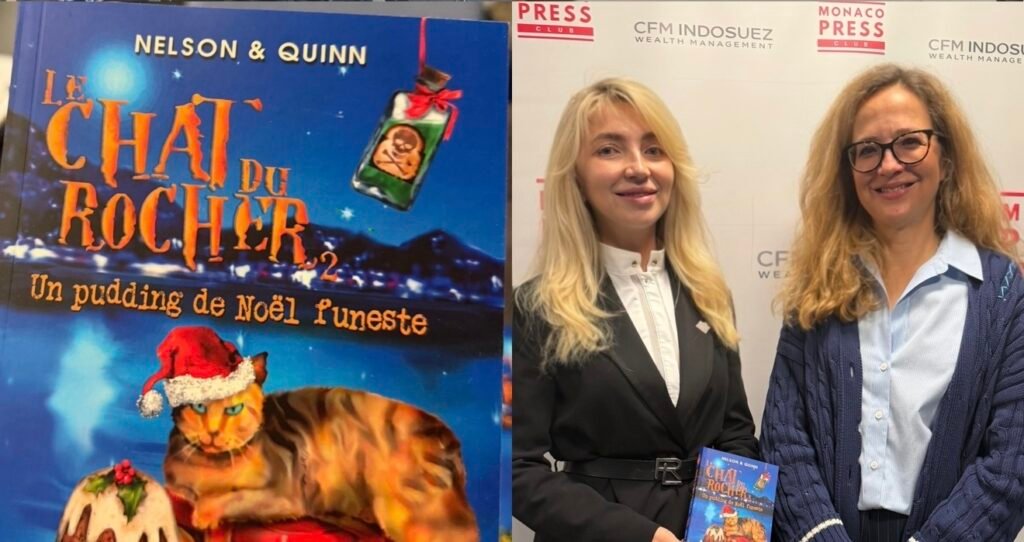
Its protagonist, Calypso, is a former television actress whose career in Brazil collapses following a personal crisis. Returning to the Rock, she becomes involved in a succession of investigations, surrounded by eccentric characters and an independent-minded ginger cat named Poker.
Cosy crime, a genre indebted to Agatha Christie, relies less on the brutality of murder than on character, atmosphere and understated humour.
Monaco provides a particularly suitable setting. The narrow streets of the old town, its close-knit community and the peculiarities of local life offer abundant material for fiction. The authors nevertheless avoid naming the principality directly, preserving the freedom to invent murders in a place better known for its security.
Writing together requires careful organisation. Ms Nelson and Ms Quinn develop their characters and outline each chapter before alternating between drafting and revision. Their different instincts prove complementary: one writer’s journalistic concision balances the other’s more expansive narrative approach.
Their collaboration has also extended beyond literature. Their Christmas romance, Love Me Doux : Un Noël givré en Provence, was adapted for the screen as An English Christmas Wish. At the Monaco Press Club gathering, Ms Nelson said that the film had been completed and outlined plans for distribution in Britain and the United States.
Artificial intelligence and the value of creativity
If digital platforms have transformed how books reach readers, artificial intelligence is beginning to change how they are written.
Ms Nelson described the appearance of AI-generated fiction on digital platforms, including entire series released at extraordinary speed. Such books compete for attention with novels that may have taken their authors months to complete.
The issue is not necessarily literary quality. The principal competitive advantage of machine-generated content is the speed and low cost of production.
Yet Ms Nelson does not oppose technological innovation. She recognises the usefulness of artificial intelligence for research, brainstorming, analysing narrative structures and preliminary editorial work.
The central question is where technological assistance ends and authorship begins.
Using artificial intelligence as a tool is one thing. Delegating the creation of an entire book to a machine while presenting it as the product of one’s own imagination is another.
For Ms Nelson, readers should be able to distinguish between the two. She envisages a future in which publishers might introduce labels identifying books written entirely by humans.
The implications extend beyond literature. Journalism faces a similar dilemma. Machines can rapidly analyse information and produce summaries, but automation may deprive younger professionals of the experience needed to develop critical thinking and editorial judgement.
Technology is becoming more efficient. Efficiency, however, is no substitute for responsibility.
The art of slowing down
Alongside her reflections on technology, Ms Nelson is developing a literary project devoted to an almost opposite idea: slowing down.
Inspired by the Slow Food movement, she has conceived a series of four romantic novels set in Tuscany, Capri, Rome and Venice. Their heroines, raised in different countries, discover that they share a nineteenth-century Venetian painter as an ancestor.
Each faces a personal upheaval that prompts her to reconsider her priorities. The first protagonist is an influencer whose life has become almost entirely virtual. Her story explores the rediscovery of genuine relationships and direct human experience.
The theme reflects Ms Nelson’s broader concerns about contemporary life. In a world dominated by social media, streaming platforms and an uninterrupted flow of information, literature must compete for increasingly fragmented attention.
As a children’s author, she is particularly concerned with encouraging younger generations to read, whether through classics, graphic novels, adaptations or audiobooks.
She has also adopted a simple rule for herself: put away the phone in the evening and pick up a book.
What remains human
Ms Nelson’s career reflects the contradictions of contemporary publishing. She has moved from journalism to fiction, from traditional publishers to digital platforms, and from individual authorship to collaborative writing. New technologies create opportunities, but they also challenge established ideas about the nature of authorship.
Literature has always relied on familiar plots and conventions. Artificial intelligence can reproduce these patterns with extraordinary efficiency. But a compelling story requires more than a well-constructed plot. Behind it lie lived experience, observation, doubt, humour and the ability to recognise something extraordinary in the ordinary.
Machines may soon be capable of producing convincing novels in a matter of minutes. Yet the speed at which a text is created does not determine its value.
Artificial intelligence may learn to tell stories. But only human beings can live them.