From Dictionaries to AI: What 35 Years in Translation Can Teach Us
A conversation with Isabelle Rossi about language, hydrography, professional instinct and the changing role of the translator.
As International Translation Day approaches on 30 September, I have been thinking more than usual about a profession that is also part of my own story. Translation was my first field of study, so conversations about language, meaning and the future of the profession inevitably feel personal.
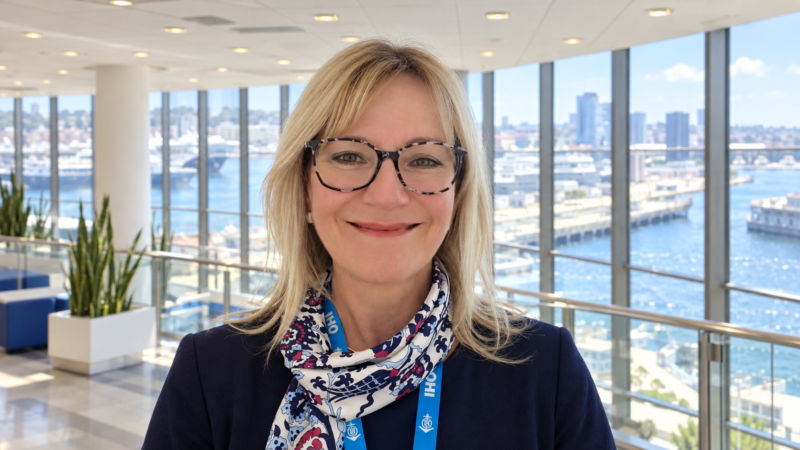
That was certainly the case when I recently spoke with Isabelle Rossi, who has spent around 35 years working with languages in the field of hydrography and at the International Hydrographic Organization.
Listening to her was, in some ways, like travelling through the recent history of translation itself.
When Isabelle began her career, there was no Google to consult, no online terminology database waiting in another browser tab, and certainly no artificial intelligence capable of producing a first draft in seconds. Instead, she remembers having a cupboard in her office filled with dictionaries — mathematical, physical, technical, and anything else that might help her find the elusive term she needed.
It is a simple image, but a telling one: a translator surrounded by books, searching patiently for the precise word.
Today, that same search may take only a few seconds.
And yet, after speaking with Isabelle, I came away wondering whether the essential part of the job has really changed as much as the tools have.
Learning to find the meaning
One of the first lessons of technical translation is knowing what you do not know. A translator working on scientific or hydrographic material is not necessarily an engineer, physicist or hydrographer — nor should they pretend to be one.
As Isabelle mentioned, the translator’s role is to reconstruct the meaning of a text accurately, even without possessing the same technical qualifications as the experts who wrote it. In her view, a certain distance can even be useful: it allows the translator to remain neutral and concentrate on meaning.
Translators are often expected to know an extraordinary amount about an extraordinary number of subjects. A good translator does not need to know everything. What matters is knowing how to find the right information, check it carefully and make sense of it before putting it into words.
In an international environment, the challenge does not always begin with terminology either.
Isabelle remembers working on technical papers written in English by authors with different language backgrounds. The writing could be accurate and technically sound, but not always idiomatic or academic.
Before translating such a text, you first had to work out what the author actually meant.
That kind of work rarely appears in the final document, but it is at the heart of what translators do: reading beyond the words on the page and recovering the intention behind them.
When the machines arrived
Isabelle has also lived through almost the entire development of machine translation as a professional tool.
At first, she was sceptical about machine translation.
The early systems demanded a great deal of investment in time and effort, while producing results that were often disappointing. The balance simply did not make sense.
“It wasn’t worth it,” she recalls.
Over time, however, the technology improved. Around ten or fifteen years ago, tools became considerably more sophisticated. Isabelle mentions DeepL as one example of how far automatic translation had come, first with a limited number of languages and then with increasingly broad capabilities.
Now artificial intelligence is accelerating that transformation again.
The question is no longer simply what machines can translate, but what remains uniquely human once the first draft can be produced almost instantly.
For Isabelle, the answer lies in revision.
“With artificial intelligence, everything is being redefined,” she told me, “but we will always need a reviewer” — someone who can control the machine, check its choices and decide which term is actually the right one.
That may be one of the clearest descriptions of where the profession is heading.
The translator of the future may spend less time producing every sentence from scratch and more time evaluating, correcting and refining what technology produces. The skill is shifting from simply generating language to judging it.
The translator’s “radar”
Isabelle works with English, French and Spanish. She can review Spanish translations produced by an external translator and identify errors even when she was not the person who wrote the first version.
As she said, she has her own “radar.”
Anyone who has worked with languages for a long time will understand exactly what she means. Professional experience creates a kind of sensitivity that is difficult to quantify. Something catches your attention. A sentence is grammatically correct, yet somehow wrong. A term seems plausible but does not belong in that context. The rhythm is off. The meaning has shifted slightly. You notice the problem before you can always explain it.
That instinct is not mysterious. It is the accumulated result of thousands of decisions, corrections and comparisons made over many years.
And in an age of increasingly powerful language technology, it may become even more valuable.
A machine can produce fluent language. Fluency, however, is not the same thing as accuracy.
Someone still has to know the difference.
A different profession for a new generation
When I asked Isabelle what she would say to young linguists entering the profession today, she did not offer an easy answer.
She paused.
The future, she suggested, is difficult to predict. But she remains convinced that linguists will continue to be needed — although the job they do will not necessarily look like the one she began 35 years ago.
In the past, a translator’s workload might be measured in pages per day. That concept has largely disappeared. Technology has removed much of the laborious side of the work, while allowing professionals to handle far greater quantities of documentation. The next generation may therefore need a broader set of skills: revision, coordination, quality control and the ability to manage much larger flows of multilingual content. There may, Isabelle acknowledges, be fewer translators in the traditional sense.
But there will still be translator-reviewers.
She compares the change to what has happened in medicine. Doctors use increasingly sophisticated imaging systems, machines and robots, yet the technology does not remove the need for the doctor. A professional remains behind the machine, interpreting and verifying what it produces. Translation, she believes, will follow a similar path.
It is a useful analogy because it moves the discussion away from the familiar question of whether AI will “replace” people. Perhaps replacement is not the most interesting way to think about technological change.
A better question might be: what becomes more important in the human role once the machine becomes capable of doing more?
Watching another change unfold
Technology is not the only transformation Isabelle has witnessed over the course of her career.
Hydrography itself has changed.
When she entered the field more than three decades ago, very few women occupied senior or leadership roles. Today, she sees more and more women taking on positions of responsibility, and the growing role of women in hydrography has become an important subject within the profession.
It is another reminder of what 35 years inside one professional world can reveal.
Much has changed between the days of paper dictionaries and the arrival of artificial intelligence. So too have ideas about who belongs in the industry and what a career in it can look like.
What remains
During our conversation, I kept returning in my mind to that cupboard full of dictionaries.
I know this feeling, I bet I am the last generation who has this nostalgia : the physical weight of knowledge, the slow search for a term, the patience required to find an answer that today might appear on a screen almost instantly.
But nostalgia can also be misleading.
Few translators would genuinely choose to give up modern tools and return to spending an afternoon searching for a term that technology can retrieve in seconds. The disappearance of that labour does not necessarily mean the disappearance of the profession.
It may simply reveal more clearly what the profession was always about.
A dictionary could never decide for the translator which word was right in a particular sentence. It could only offer possibilities.
For all its sophistication, AI does not remove the translator’s responsibility; in some ways, it makes that responsibility more visible. A system can suggest a term, produce a fluent sentence or process vast amounts of text in seconds, but fluency is not the same as accuracy. The final judgement still belongs to the person who reads carefully, questions what looks convincing, notices when the meaning has shifted and decides what should ultimately reach the reader.
Perhaps that is why Isabelle’s outlook, after 35 years of watching her profession change, is neither nostalgic nor alarmist.
She ended our conversation on a simple note: “We have to remain optimistic.”