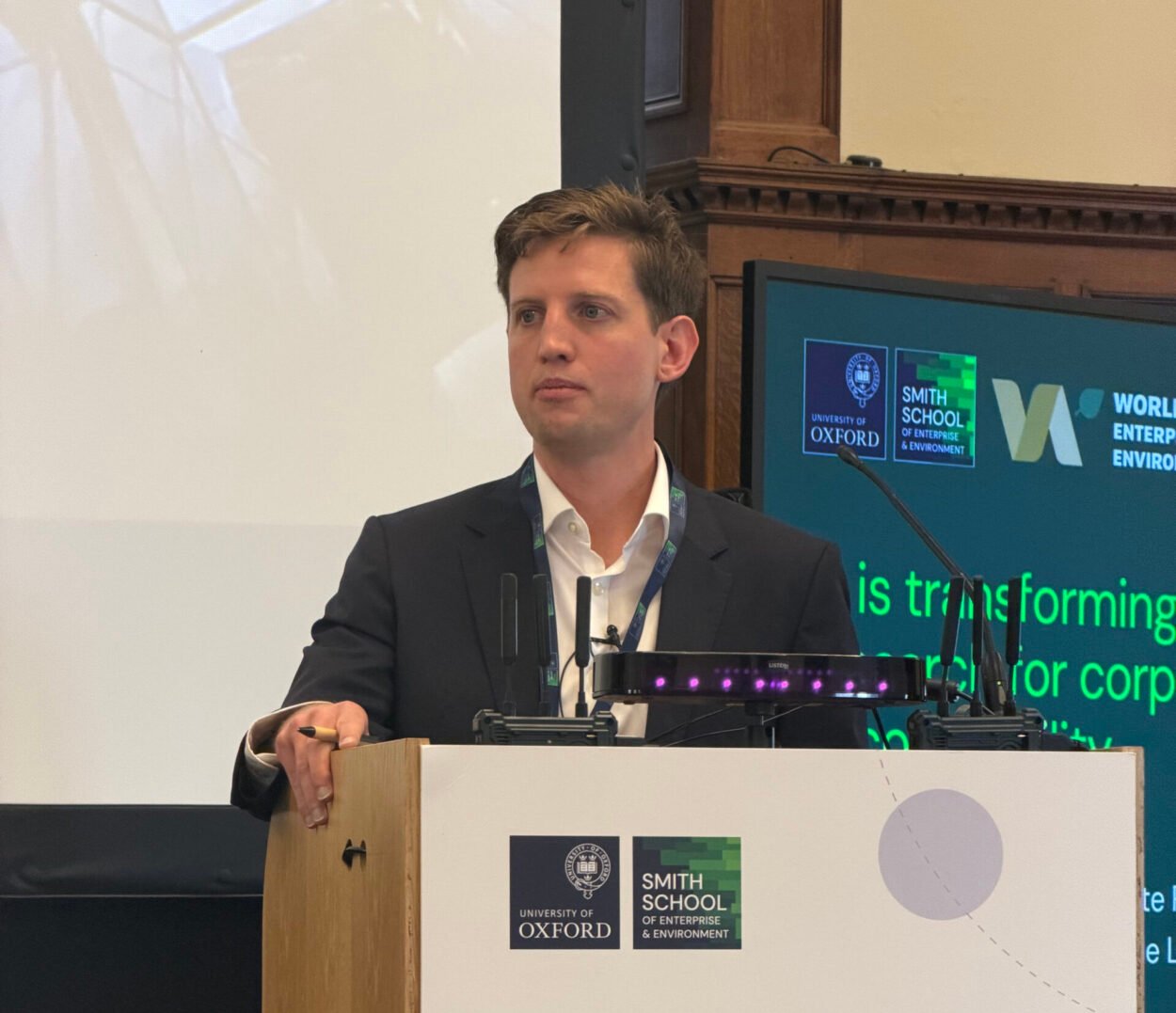
Interview with Dr. Benjamin Franta: “Companies Knew About the Climate Risks”
Dr. Benjamin Franta is an Associate Professor at the Oxford University Sustainable Law Programme, where he researches climate litigation. He studies internal fossil fuel industry documents and how historical evidence can help hold companies accountable for climate damage. We talked about the future of climate litigation, AI’s place in research, and the documents he continues to return to during the 2026 Oxford University World Forum on Enterprise and the Environment.
How did you come to study climate change and litigation?
I started out as a physicist, working on renewable energy, including solar power. But over time I realised that the climate problem was about more than technology. It was also about politics and society.
I became interested in why we hadn’t made more progress on climate change over the past 30 or 40 years. I began studying the history of climate denial and obstruction, and then learned about litigation and how the law can help bring about change.
In tobacco litigation, historians played an important role in establishing what companies knew about addiction and harm to health. I thought that approach could also be useful in climate cases.
What is at stake in cases against fossil fuel companies?
The U.S. Supreme Court’s decision could have a significant impact on the future of climate damage lawsuits. Cities and states are bringing cases against companies, alleging that they concealed what they knew about climate change and misled the public.
The amounts involved could be enormous—perhaps hundreds of billions of dollars, or even trillions. If these cases are allowed to proceed, they could become some of the largest in legal history.
Where do you expect new climate lawsuits to emerge?
I think we’ll see more cases not only in the United States and Europe, but also in countries across the Global South—in Asia, Africa, Latin America and India. The effects of climate change are becoming more visible, and scientists are getting better at measuring the damage. At the same time, we’re finding more historical evidence that companies knew about climate risks and did not always communicate them honestly to the public.
Low-lying Pacific islands are particularly vulnerable to rising sea levels, cyclones and coral reef loss. Internal documents from oil companies have even included specific predictions, such as the risk of flooding in Bangladesh. Evidence like this could matter in future court cases.
Can AI help find evidence, and could it also make that evidence harder to trust?
AI can be a useful assistant. It helps us search for documents and gather relevant evidence. But the information still needs to be checked by a person reading the original sources. There’s no substitute for examining the documents ourselves.
I would distinguish between using AI to search and using it to write legal materials. Writing with AI can lead to errors, inaccuracies or fabricated information. When AI is used to search, a person can open the documents, verify them and draw their own conclusions.
What is holding back the growth of climate litigation?
We need research that gives these cases a strong foundation. We need more lawyers and law firms willing to work in this area, as well as researchers studying scientific evidence and historical documents.
It’s important to understand not only what happened, but also what outcome we want from a case. We need to think carefully about legal remedies that could actually help address the problem.
Was there a document that particularly surprised you?
Yes. I once spent a week in an archive, going through documents for about ten hours a day, and found almost nothing interesting. On the last day, I came across an old book about the physicist Edward Teller. The oil industry had invited him to speak at a conference, and in 1959 he warned the audience about climate change.
That was a shock to me. Like many people, I had assumed that climate science was relatively new. But the document showed that people were already warning about the risks in the 1950s.
You also found internal documents from Shell. What did they show?
They were scenario reports from the 1980s. Shell considered different possible futures, depending on whether the world continued to use large amounts of fossil fuels or reduced its consumption.
The high fossil fuel scenario predicted consequences we see today: flooding, conflict and displacement. That matters to me because it shows that the path we took was not inevitable. There was an alternative.
What does this say about corporate accountability?
It raises questions about how corporations should be governed and held accountable. Companies may argue that everyone benefited from their activities, including governments. But in an alternative future, we would still have had energy—just safer, cleaner energy.
We could have made that transition sooner and had a healthier planet.