Monts d’Azur: The Morning a Bison Reminded Me I Was Only a Guest
The first creature I met last morning wasn’t a person. It was a European bison.
Just after sunrise, I stepped onto the terrace with a cup of coffee as the first light spilled across the limestone peaks of the Préalpes d’Azur. The air carried the scent of wild thyme and pine. Swallows skimmed silently through the cool morning sky.
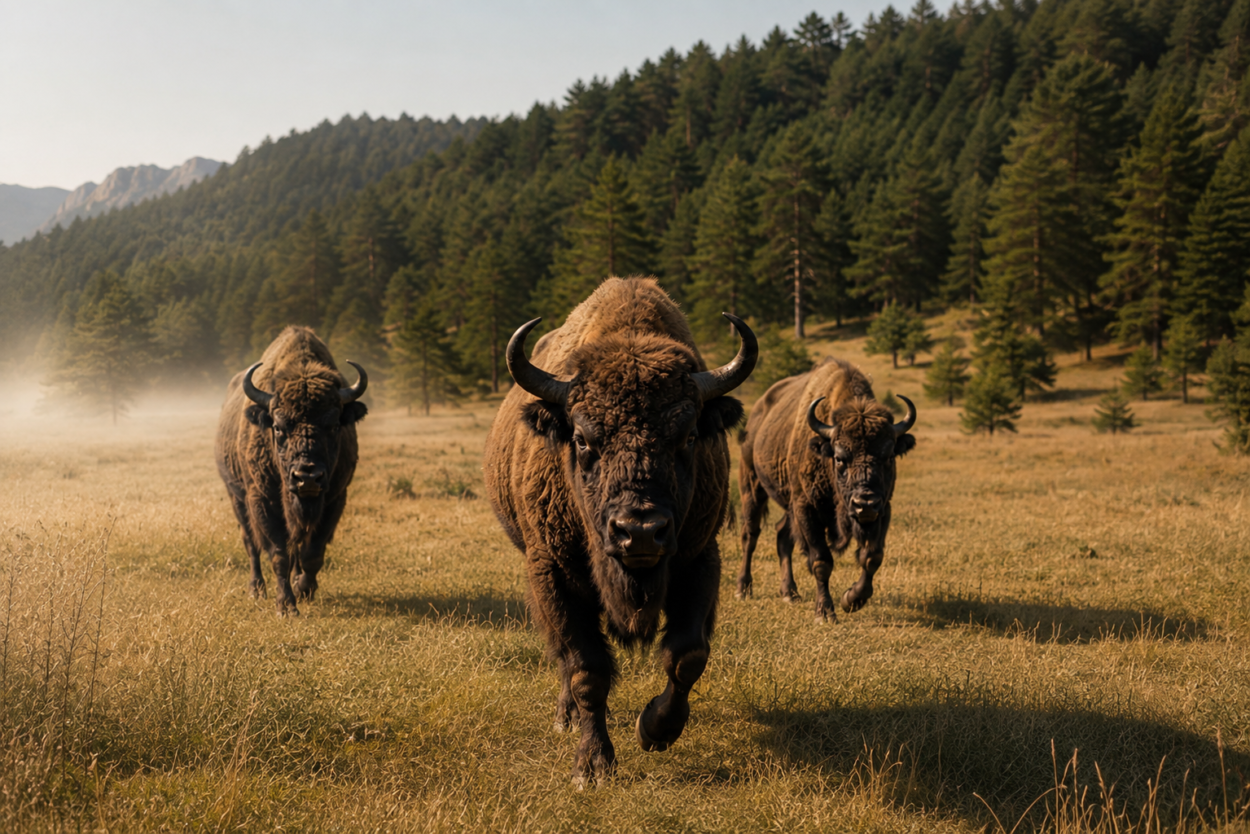
Then, without the slightest concern for my presence, a massive European bison wandered out of the tall grass.
He never looked at me. He wasn’t curious. He wasn’t performing.
For the first time in a long while, I experienced something we’ve almost forgotten in the modern world.
Nature wasn’t visiting me. I was the guest.
That single encounter became the lens through which I experienced everything else at RESERVE BIOLOGIQUE DES MONTS D’AZUR .
Spread across more than 700 hectares in the French Alps, this isn’t a zoo. It’s one of Europe’s most ambitious rewilding projects—a place where ecosystems, not people, set the rules. Here, forests, wetlands, meadows and rocky hillsides are allowed to function much as they once did, long before Europe’s wilderness disappeared.
Later that morning, I found myself surrounded by an entire herd of European bison.
They moved slowly through the golden grass with an almost prehistoric calm, as if nothing had changed for thousands of years. Watching them, it wasn’t difficult to imagine the Europe that once existed—vast forests stretching across the continent, where these giants shaped the landscape long before roads, cities and agriculture transformed it.
Then came another unforgettable encounter.
Przewalski’s horses.
The last truly wild horse on Earth.
Declared extinct in the wild during the twentieth century, they survived only because of captive breeding programs before one of history’s greatest wildlife reintroduction efforts brought them back.
Seeing them graze freely was a quiet reminder that extinction doesn’t always have to be the final chapter.
Red deer emerged cautiously from the forest.
Above us, swallows filled the sky, catching insects with astonishing precision. As evening approached, bats silently took over, continuing the rhythm of a landscape that never really sleeps.
Nothing here exists in isolation.
Every species shapes the land.
Every absence would change it.
But none of this happened by accident.
Behind every meadow, every herd and every peaceful encounter is the vision of one remarkable family.
Years ago, French veterinarian and conservationist Patrice LONGOUR was working in Botswana when a local conservationist asked him a question he could never forget:
“Why do Europeans come to teach us how to protect wildlife when Europe has already lost so much of its own?”
The question changed everything.
Together with his wife, Alena Longour , Patrice decided not simply to protect wildlife—but to restore it.
They purchased the historic Domaine du Haut-Thorenc and spent years transforming it into what became RESERVE BIOLOGIQUE DES MONTS D’AZUR, opening its gates in 2006.
Their goal was never to build another wildlife park.
Instead, they wanted to rebuild functioning ecosystems where large herbivores could once again shape the landscape naturally—grazing grasslands, dispersing seeds, opening forests and restoring ecological balance in ways humans never could.
Today, Monts d’Azur is home to European bison, Przewalski’s horses, red deer, wild boar and hundreds of other species. More than 500 animal species have been recorded here, making it one of southern France’s richest biodiversity hotspots.
The numbers tell one story. Living this place, even for a day, tells another. Somewhere between the morning light, the slow movement of the bison, and the stillness of the valley, you find yourself slipping into a different rhythm—one that has nothing to do with schedules and everything to do with paying attention.
I didn’t leave Monts d’Azur with a perfect photograph.
I left with something far more difficult to describe: the feeling of having briefly belonged to a landscape that needed nothing from me.
Perhaps that is the rarest kind of journey.