Monaco Takes the Lead: La Vuelta’s Grand Départ in the Principality
Monaco has always had a particular talent for making scale feel irrelevant. Its territory may be compact, but its sporting ambitions rarely are. Formula 1, tennis, sailing and major international competitions have long turned the Principality into a stage whose global visibility far exceeds its size. Now cycling is preparing to join that tradition.
With the Grand Départ of La Vuelta approaching, Monaco is entering the final phase of an operation that has been more than a year in the making. Behind the images that will soon travel around the world lies a carefully choreographed exercise involving security services, volunteers, transport networks, road crews and virtually every layer of the Principality’s administration.
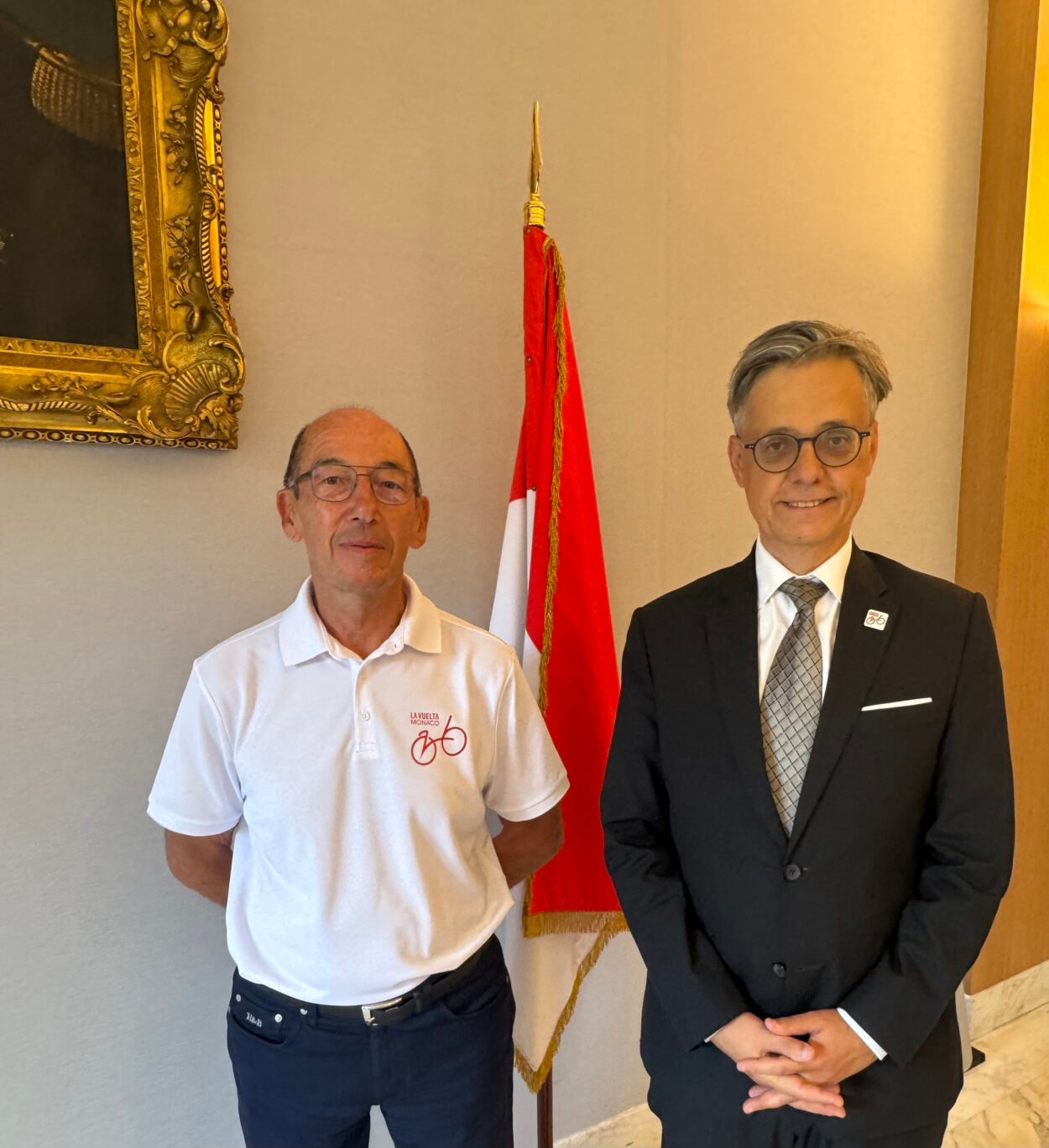
At a press meeting ahead of the event, Monaco’s Minister of the Interior Gouvernement Monaco , Lionel Beffre, and Christian Tornatore, Commissioner General of the Grand Départ, offered a glimpse of what it takes to bring one of cycling’s great races to one of the world’s most distinctive territories.
The figures alone give an idea of the scale. Around 300 public-service personnel are expected to be mobilised, alongside as many as 160 private-security staff. Emergency services will also be deployed, while Spanish police officers will join the operation — a relatively small presence numerically, but an elegant symbol of the international cooperation behind the start of Spain’s most famous cycling race.
For Monaco, however, the challenge is not merely to host La Vuelta. It is to do so in the distinctly Monegasque way: efficiently, elegantly and with an extraordinary attention to detail.
That means thinking about everything from policing to pavement.
Officials stressed that the condition of the roads must be close to perfect for professional riders. The department responsible for infrastructure has therefore been closely involved in preparing the course. It is a small detail from the spectator’s point of view, but a revealing one. In Monaco, the success of a major event is often built on precisely the things the public is never supposed to notice.
The same is true of crowd management. Volunteers will help spectators navigate the route and cross it at designated points whenever race conditions allow. In a larger city, a road closure may simply redirect traffic elsewhere. In Monaco, where streets, neighbourhoods and public spaces are tightly interconnected, the choreography has to be considerably more precise.
And yet this constraint is also part of the Principality’s strength.
Monaco has decades of experience turning geographical limits into organisational advantages. Everything is close; decisions can be coordinated quickly; public authorities, organisers and services operate within a remarkably concentrated environment. What could look like a logistical difficulty elsewhere becomes, in Monaco, an exercise in precision.
The event itself will unfold over several days rather than being reduced to a single moment on the start line. The programme includes the presentation of the teams and the competitive stages before the race continues beyond the Principality. For Monaco, it means several days in which the country will not simply host the race but effectively become part of it.
That distinction matters.
When I asked Lionel Beffre what place cycling occupies in Monaco’s sporting identity, his answer moved beyond the mechanics of the Grand Départ. He spoke about a Principality known for major events, but also for its clubs, associations and an established culture of sport. La Vuelta, in his view, fits naturally into that identity and into Monaco’s tradition of welcoming major cycling events.
It was perhaps the most revealing point of the meeting.
Monaco does not need sport simply to attract attention. It already commands an unusual degree of international recognition. Rather, sport has become one of the languages through which the Principality expresses itself: competitive, international, highly organised and unmistakably visual.
La Vuelta is particularly well suited to that image.
The race will pass through a setting instantly capable of becoming a postcard: the Mediterranean, the density of the city, its elevation changes and its architecture all compressed into a few kilometres. The riders may be the protagonists, but Monaco will inevitably share the screen.
And that screen matters. The spectators arriving in the Principality are only one part of the audience. Organisers have been preparing access by road, rail and bus and expect international visitors along different parts of the route. But millions more will experience the Grand Départ from elsewhere, through television pictures and photographs in which the race and Monaco will be almost impossible to separate.
Once La Vuelta leaves, the barriers will come down and ordinary traffic will return. The peloton will continue its journey, as cycling races always do. But Monaco will have added another major international event to a sporting calendar that is already exceptional for a country of its size.
The Grand Départ therefore offers something more enduring than a few hours of racing.
It is another demonstration of a quality Monaco has cultivated particularly well: the ability to take a limited amount of space and give it an international dimension.
For a small Principality, Monaco has never thought small.