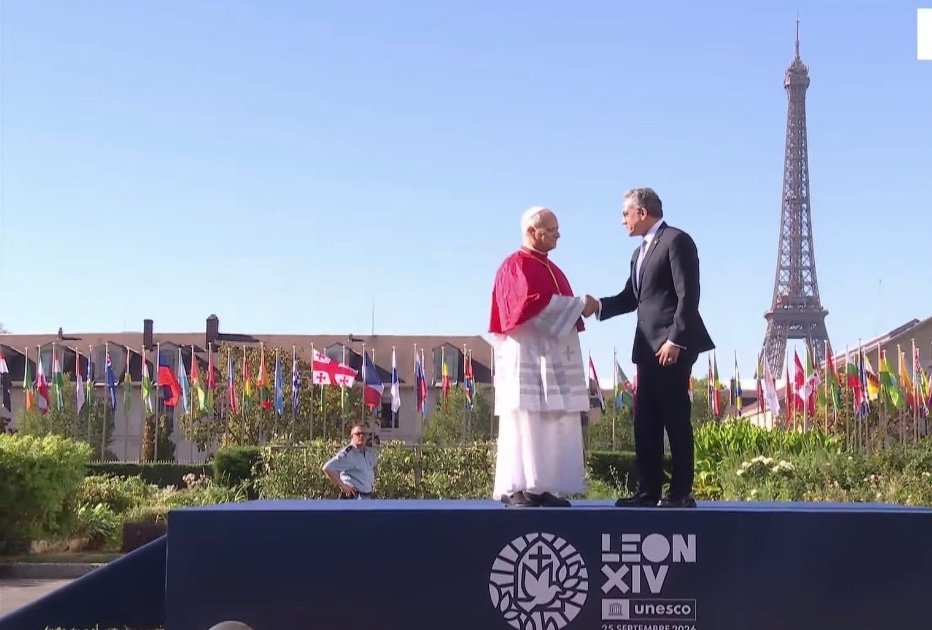
What Is a Human Being For?
Pope Leo XIV brought an awkward question to Paris — first for the machines, then for the French Republic.
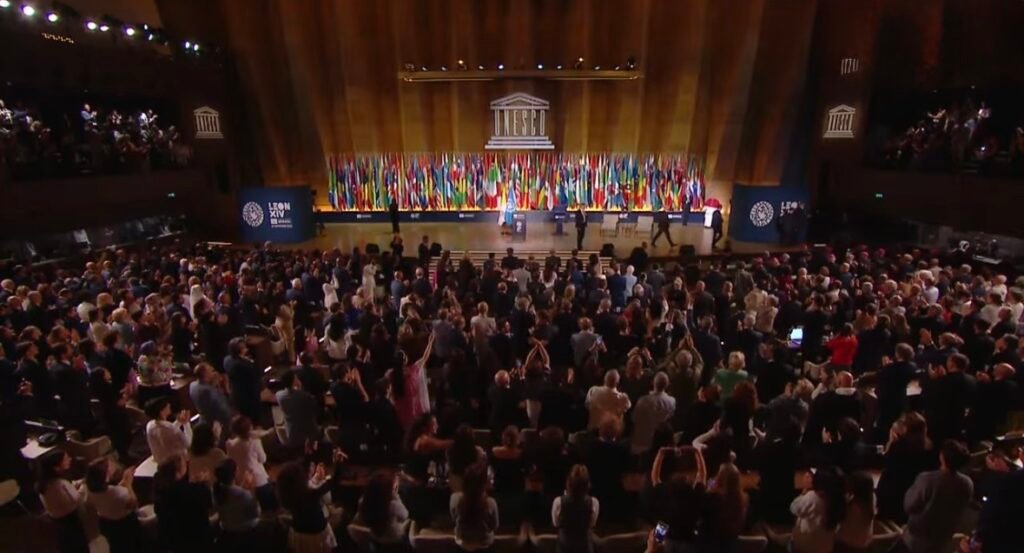
What if the real danger of artificial intelligence is not that machines become too human, but that humans become too much like machines? That was the question that occurred to me listening to Pope Leo XIV at UNESCO in Paris.
There were diplomats, academics, familiar faces and the usual choreography of international diplomacy. Among them was Princess Lamia — a small but telling reminder, in a room devoted to dialogue between cultures and faiths, that such dialogue is not merely an institutional aspiration. Sometimes it is simply visible in who is willing to sit in the same room.
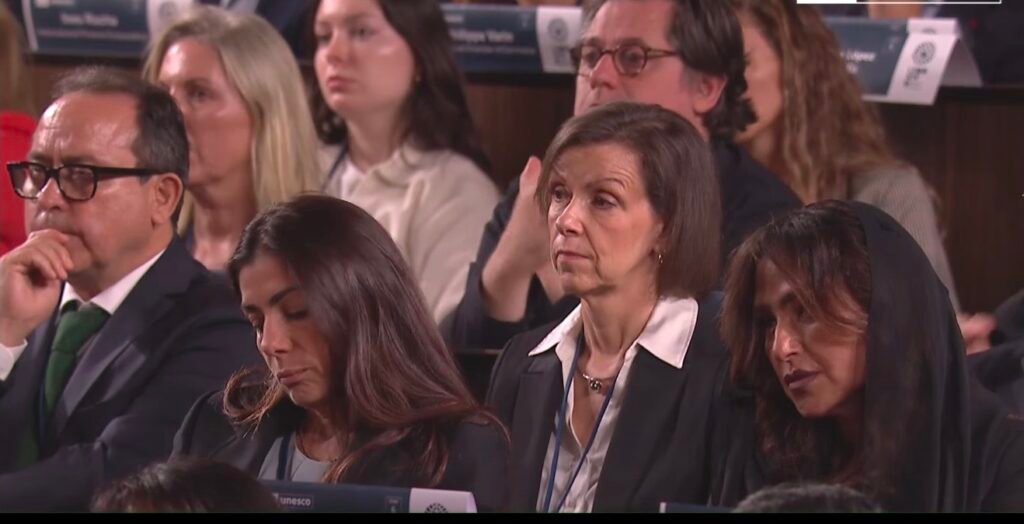
Then the Pope abandoned the usual diplomatic fog:
“Information is abundant, but that is not synonymous with wisdom.”
It is difficult to imagine a neater description of 2026.
We have built machines capable of absorbing libraries in seconds, imitating voices, manufacturing images and supplying answers before we have properly formulated the question.
The Pope seemed rather less alarmed by the prospect of intelligent machines than by the prospect of machine-like humans. A civilisation that judges everything by efficiency and output may eventually discover that people are inconveniently inefficient creatures.
At the beginning of his UNESCO address, Leo warned of a process of dehumanisation in which people are assessed according to efficiency and discarded when they are no longer considered productive. Human dignity, he insisted, does not diminish with vulnerability.
That distinction matters. Modern societies have become remarkably good at measuring value, and rather less confident about saying what value is. Leo captured a problem in one sentence:
“Meaning is the oxygen of the mind.”
Artificial intelligence can correlate data, he argued, but it cannot answer the questions that give human life meaning, because meaning belongs to lived experience. Silicon Valley has become extraordinarily good at answering how; the Pope was interested in the rather older question of why. And it was here that what might have been another predictable speech about technology widened into something more ambitious. Leo turned to the Tower of Babel.
His modern Babel is not a computer. It is a civilisation organised around power: globalisation without fraternity, ideological imposition, human life reduced to commerce and science reduced to a “technique of power”.
The metaphor is almost suspiciously well suited to the digital age. Babel was, after all, an impressive technological project. Its failure was not one of engineering.
Against it Leo offered another biblical image: Pentecost.
People remain different. They speak different languages. They do not become culturally interchangeable. And yet they understand one another.
“Communion in no way suppresses diversity; rather, it enables diversity to flourish.”
It was a pointed message to deliver at UNESCO, an institution founded on the proposition that different cultures can find common ground without first becoming the same culture.
But the Pope had not come to Paris merely to lecture the machines.
Earlier that day, at the Élysée Palace, the same argument had acquired political teeth. The official programme placed his meeting with President Emmanuel Macron and his address to political leaders, civil society and diplomats before the UNESCO speech.
At UNESCO, the target was the machine. At the Élysée, the argument turned on the Republic itself.
Questions of meaning became questions of law.
What had sounded philosophical at UNESCO — What is dignity? What is freedom for? Are there limits to choice? — became arguments about laïcité, surrogacy, genetic manipulation, assisted dying and the place of religious conscience in public life.
Leo told the French authorities that he was concerned by trends capable of turning science and technology into profit-driven enterprises involving genetic manipulation, surrogacy, organ trafficking and the possibility of arranging one’s own death. He also argued that an “authentic secularity” should not mean removing religion from public life or education, but allowing the state and religious institutions to remain in dialogue.
France has its own powerful conception of autonomy, citizenship and laïcité. Catholic social teaching starts somewhere else: with the claim that human dignity exists before the state, before the market and even before individual preference.
Those two traditions sometimes overlap. They do not always arrive at the same conclusions.
The friction is particularly clear over the end of life. Leo’s remarks came as France had moved to establish a legal right to assisted dying under specified conditions — a development opposed by the Catholic Church.
One need not share the Pope’s conclusions to see the question he is pressing.
If human dignity is truly inherent, rather than something determined by autonomy, productivity or social usefulness, what limits does that place on what individuals, markets and governments may legitimately do?
That question is far harder than the familiar argument over whether the Church is sufficiently modern.
The inconvenient human being
At UNESCO, Leo made the same argument through the people least likely to win a contest based on efficiency.
He spoke of the unborn, the elderly, migrants, refugees and those dismissed as “unproductive”. They are, in his account, the test of whether talk of human dignity means anything when a person possesses little economic, physical or political power.
Here the two Paris speeches meet.
An AI system optimised for efficiency and a modern state built around individual autonomy may appear to belong to completely different debates. Leo’s challenge to both is remarkably similar:
Is there something about a human being that cannot be reduced to calculation, usefulness or choice?
The Pope has a theological answer, of course. Secular societies have several, and they do not always sit comfortably together. What struck me at UNESCO was how difficult it has become even to agree on the question. We have more information, more ways to communicate and more technological power than any generation before us. Leo’s point was simply that none of this tells us what a human being is for.
Near the end, he returned to trust — an almost old-fashioned word now. Trust that difference need not be threatening, and that disagreement need not end the conversation. Perhaps that was the thread running through his Paris visit: not a warning against technology so much as a warning against the assumption that, because we can do something, we therefore ought to.
There are limits to what measurement can tell us, just as there are limits to what power ought to permit. A society can become more sophisticated without becoming more humane. Machines will grow more capable; states will acquire new ways of managing life, and individuals new ways of reshaping it. The harder question is whether all this capability will make us wiser — or simply more powerful.
Babel, after all, was not a technological failure. It was a failure of purpose.