The Newsroom After AI: Agnès Vahramian in Conversation with Bernard de La Villardière
At the Press Club de France, a conversation about AI, trust, and why being there still matters.
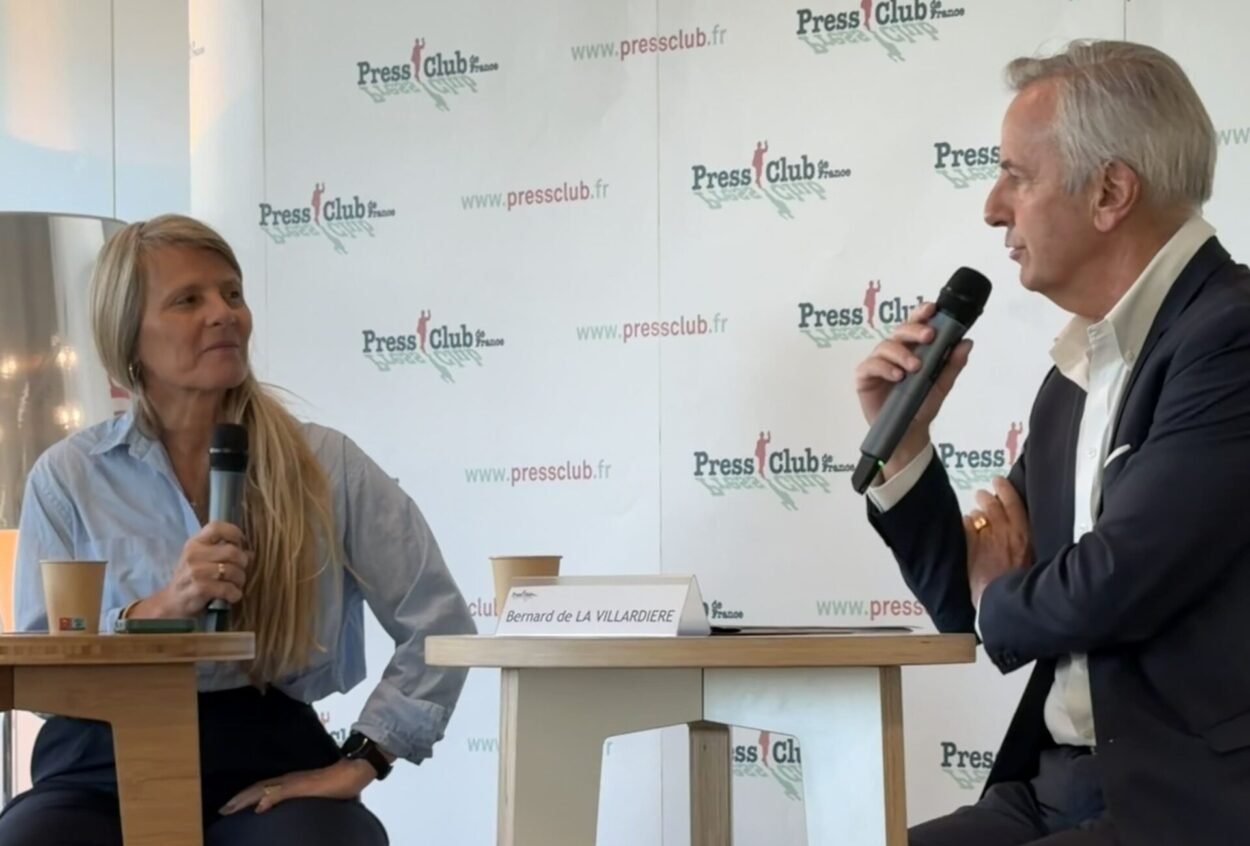
Managing journalists is hardly the most obvious prescription for reducing stress. Bernard de La Villardière, president of the Press Club de France, hinted at as much at the start of his conversation with Agnès Vahramian, director of franceinfo. Running a newsroom is difficult enough; doing so inside Radio France — an institution with a long history, entrenched habits and considerable institutional weight — makes the job more interesting still.
Vahramian, however, gives the impression of someone more intrigued by difficulty than intimidated by it. When she arrived at franceinfo, she did not try to invent a new identity for the station. Instead, she wanted to return it to what she sees as its natural territory: live broadcasting, reporting and l’actualité chaude — news as it happens.
She reduces the station’s mission to two verbs: to know and to understand. France Inter, she explains, leans more towards conversation and analysis; France Culture towards the transmission of knowledge. Franceinfo’s first task is to tell people what is happening now, then help them understand why it matters.
The more AI, the more valuable presence becomes
The conversation soon turned to artificial intelligence. But the franceinfo director does not suggest that journalists try to beat machines at speed. Rather than seeing AI as a competitor, she uses it as a test: what still matters when the machine can do the rest?
“I leave AI what AI can do, and I take what AI cannot do.”
Above all, AI cannot be there.
It can gather already published information, summarise it and process volumes of material that would have seemed extraordinary to a newsroom not long ago. But it cannot travel to the scene of an event, speak to a witness, hear hesitation in an answer or notice the detail that never made it into an official statement.
Soon after taking over franceinfo, she strengthened its reporting teams. In this view, technology does not make field journalism obsolete. If anything, it restores its value.
“In my view, AI will not kill journalism.”
It may profoundly alter the information market, the way news is distributed and the habits of audiences. But journalism itself begins when someone leaves the newsroom, observes, checks and brings back something that was not already circulating.
There is no shortage of information today. What is becoming scarce is the presence of someone who actually saw what happened.
Hence one of her more surprising pieces of advice to young reporters:
“Speak more slowly.”
Coming from the head of a rolling-news station, it is a curious piece of advice. But her point is straightforward: people are not short of news; they are surrounded by it from the moment they wake up, with alerts, videos, headlines and social feeds competing for attention.
But she is not arguing for softer news. Difficult subjects remain difficult; the task is to make them clearer. By adding context, causes and connections, journalism cannot make bad news better, but it can make it easier to understand — and perhaps a little less overwhelming.
She applies the same principle to the length of a report. The old newsroom instruction — you have one minute — does not particularly convince her. If a story needs two and a half minutes, give it two and a half. If it needs four or five, that is how long it should have.
Vahramian spent more than three decades in television, so she watched the evolution of formats from the inside. There was a time when a five-minute television report seemed almost an extravagance. Gradually, the boundaries expanded, and some news formats began to resemble documentary storytelling.
Length is not the point; the story should dictate the format, not the other way round.
Radio that lets you see
Duration is only part of the idea. At one point she recalled a franceinfo bulletin that had particularly irritated her. The event itself was dramatic; there were striking images and videos. Yet on radio, it somehow sounded almost sterile.
What was missing was the sound of the event itself : the street, people’s voices, the atmosphere of the place.
After a long career in television, Vahramian still describes herself as a person shaped by images. Perhaps that is why she expects something almost visual from radio: the listener should not merely learn a fact, but be able to picture what is happening.
For her reporters, the rule is simple:
“Tell me stories.”
Not fiction, but narrative: voices, movement, detail and the sound of a place. De La Villardière approached the same question from another direction, suggesting that listeners need a fil rouge — a recognisable person to guide them through the news. Franceinfo has traditionally relied less on star presenters than generalist stations, since listeners come first for information; yet, as Vahramian acknowledges, efficiency can easily become coldness. So the aim is to bring in more warmth and presence without turning the station into personality-driven radio. At the same time, traditional media have had to absorb one lesson from social platforms: audiences now expect to be addressed more directly and naturally. That does not mean simplifying the language; rather, the delivery should feel alive, with rhythm, pauses and changes of tone. And so the paradox becomes clear: the more machines surround us, the more important it is for a journalist not to sound like one.
What if the reader no longer comes?
She seems relatively relaxed about AI replacing reporters; the economics of digital media are another matter. Until recently, a reader would type a question into a search engine, follow a link and arrive at the newsroom that had paid to produce the answer. Increasingly, however, the answer appears before the click. That changes not only the reader’s route but also the business of attracting an audience. Hence the push to make franceinfo a destination media brand — somewhere people choose to visit directly rather than somewhere an algorithm happens to send them. For a free public-service outlet, that is especially difficult: a subscription creates its own reminder, whereas a free service has to earn the habit every day.
That, in turn, means rethinking the app, video, audio and the way formats work together. Yet more output is not necessarily the answer. Vahramian is wary of expecting every journalist to film, record, write, edit and publish across several platforms at once; trying to do everything can be an efficient way of doing everything badly. The same applies to platforms themselves: a video shot by the first reporter at the scene of a train accident clearly has value, while another clip produced simply because a strategy document says video may not. She also pointed to media organisations that have cut the volume of what they publish in favour of quality and loyalty. After years in which digital strategy largely meant “produce more”, producing less — but better — begins to sound almost radical.
An old craft
Trust, though, is the harder thing to manufacture. Franceinfo has teams devoted to verification and contextualisation — a word Vahramian prefers to the more martial language of “fighting disinformation”. The job, as she describes it, is often less heroic: work out what happened, explain why it matters and let the argument breathe.
If a minister makes the case for a reform, the audience should hear the case against it too.
“We make the contradiction heard,” she says.
It is a rather unfashionable description of journalism, and perhaps a useful one. For all the talk of apps, algorithms and artificial intelligence, her prescription is strikingly traditional: go there, listen properly, check what you are told and explain it clearly. In a world awash with instant answers, those old habits may turn out to be the scarce ones.