From Monaco to Busan : the IHO maps a New Digital Future
From Monaco to Busan, the International Hydrographic Organization is entering a new phase: digital standards must become operational infrastructure, while ocean knowledge must become accessible to countries with very different technological capabilities.
Maritime navigation is rapidly moving into the digital age. Yet beneath vessels equipped with increasingly sophisticated information systems, a considerable part of the ocean floor remains insufficiently mapped.
For the new leadership of the International Hydrographic Organization (IHO), these two realities are inseparable. A digital ocean cannot be built without sufficiently precise knowledge of what lies beneath its surface.
The IHO’s new strategic period for 2027–2032 is centred on three priorities: navigating the digital transition, mapping the unknown and building for the future.
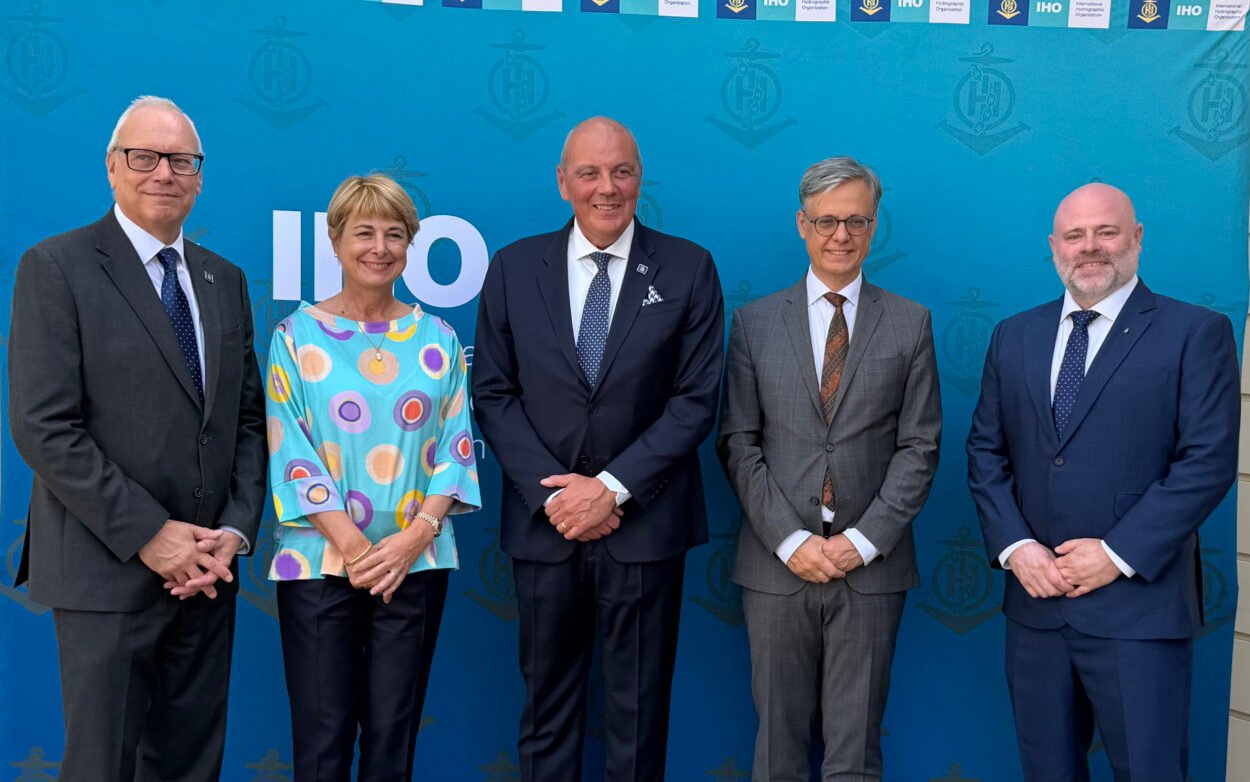
Each of the organisation’s three senior leaders has a distinct role in this transformation. Secretary-General Luigi Sinapi is setting the strategic direction. John Nyberg, Director of the Technical Programme, is focused on infrastructure and the implementation of new standards. Adam Greenland is responsible for inter-regional coordination and for developing capacity among states with very different levels of hydrographic capability.
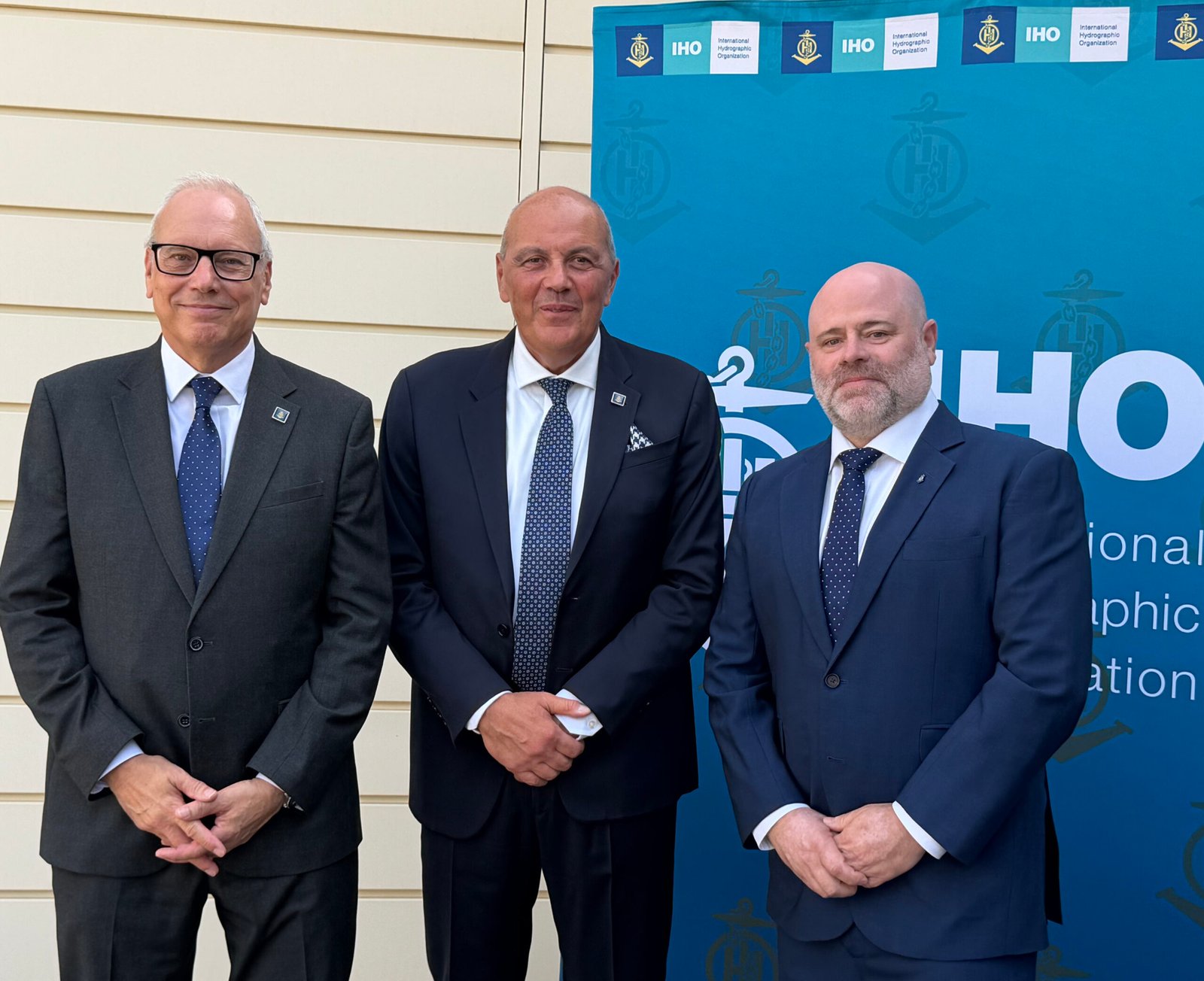
Together, they are shaping an IHO that intends not only to develop international standards, but increasingly to turn them into practical tools.
From standards to results
For Sinapi, modern hydrography has long since moved beyond its traditional role of ensuring safe navigation.
In his address, he linked hydrography to ocean governance, the maritime economy, environmental protection, ocean science and digital transformation. One of the principal tools of that transition will be the S-100 framework. According to Sinapi, this is no longer simply about a new generation of electronic charts, but about creating a common language for the digital ocean — one capable of bringing together different types of marine data and providing more precise and dynamic information.
But the transformation must also extend to the organisation itself.
Sinapi said the IHO intends gradually to move from a predominantly standard-setting role towards a more operational model — while retaining its position as an international reference point for hydrographic standards and placing greater emphasis on their practical implementation:
“Turn standards into capability, and cooperation into results.”
Two new areas of activity will give practical expression to that strategy. In Monaco, a structure linked to global bathymetric mapping is being developed, while in Busan, South Korea, the IHO is establishing an infrastructure centre focused, among other priorities, on the international deployment of S-100. According to Sinapi, it will give the organisation a permanent operational presence outside Monaco for the first time.
Speaking separately with Ad Astra, Sinapi expressed the significance of hydrography:
“Hydrography is the basis of all development in the marine environment.”
The infrastructure of the digital ocean
If Sinapi is defining the direction of travel, John Nyberg’s task is to make that strategy technically achievable.
In his official remarks, he described the future centre in Busan not simply as a new office, but as an answer to a specific question: how can international standards be transformed into systems that can be deployed globally and sustained over many years?
Recruitment has already begun for senior engineers, technical specialists and experienced managers. Nyberg was clear that this is not intended to be a temporary initiative, but long-term infrastructure.
Speaking with Ad Astra, Nyberg explained that digital transformation is changing the entire chain of marine data — from the way information is transmitted from shore to ship to the way users receive, combine and interpret it. Data accuracy will become increasingly important, as will the readiness of users themselves to learn how to work with new systems.
Nyberg also offered another way of explaining the significance of hydrography: through the familiar concept of infrastructure.
Roads and railways are readily understood as infrastructure because they are visible. Hydrographic systems are far less apparent, even though safe navigation and maritime transport depend directly upon them. Nyberg noted that their importance often becomes visible to the wider public only when something goes wrong.
Closing the gap
Adam Greenland approaches the digital transition from a different perspective: developing the technology is not enough — countries must also be able to use it.
In his official address, he acknowledged directly that hydrographic capabilities are developing unevenly around the world. Some countries operate world-class hydrographic services, while others are only beginning to build the necessary expertise. His task, as he described it, is to close that gap through inter-regional coordination, capacity-development programmes and the network of 15 regional hydrographic commissions.
For Greenland, human capital is therefore every bit as important as technology.
IHO programmes include e-learning, technical visits and initiatives aimed at strengthening professional expertise, including programmes supporting women in hydrography. His point is straightforward: infrastructure alone guarantees little if there are no trained professionals behind it.
“A chart is only as reliable as the surveyor, the cartographer and the hydrographic office behind it. Investing in people is investing in safety of navigation itself.”
Speaking with Ad Astra, Greenland also cautioned against an overly simplistic view of digital transformation.
In the past, the hydrographic system was largely centred on one principal product. Today, the transition involves several interconnected digital products and an entirely different ecosystem.
That is precisely why disparities between countries matter so much: states are entering the digital era with very different technological resources, levels of experience and human capacity.
Greenland also stressed the need to continue attracting and training a new generation of specialists. He stopped short of describing the situation as an outright shortage of young hydrographers, but said the profession must continue to build expertise and encourage both young men and young women to enter the field.
Asked by Ad Astra about young people, Sinapi put the point even more succinctly:
“It is often young people who make the difference. We invest a great deal in young people.”
That emphasis on the next generation also reflects a broader theme running through the IHO’s new direction: how to build for the future without losing the institutional legacy on which it rests. Nowhere is that continuity more visible than in Monaco.
From Monaco to a global system
The IHO has been closely associated with Monaco for more than a century. Sinapi described the Principality not merely as the location of its headquarters, but as part of the organisation’s history and identity, highlighting Monaco’s contribution to ocean science and international cooperation.
Now, the organisation’s geographical footprint is expanding.
Busan will become the first location outside Monaco where the IHO will have permanent operational infrastructure. At the same time, Monaco is expected to strengthen its role in global ocean mapping and international cooperation in marine knowledge.
Speaking with Ad Astra, Nyberg described that relationship not in the language of institutional strategy, but through what he called the “spirit of Monaco” — a commitment to the sustainable future of the ocean and its protection for generations to come. He linked that outlook to the IHO’s work on safe, efficient and environmentally responsible maritime transport.
A new geography of the organisation is therefore taking shape: its historic centre in Monaco, technical infrastructure in Busan, and a network of states expected to implement the new standards from very different levels of readiness.
Mapping the unknown
Yet behind the digital standards, infrastructure centres, professional training and international coordination lies a more fundamental challenge. A considerable part of the ocean floor remains insufficiently mapped.
When Ad Astra asked Greenland which issue in global hydrography deserved greater public attention, he pointed to seafloor mapping. More new data needs to be collected, he said, while existing data must also be made more accessible.
This is one of the central paradoxes of the digital age at sea. Technology is becoming more sophisticated. Data is becoming more immediate. Systems are becoming increasingly interconnected. But everything begins with a simple question: what is actually beneath the surface?
As John Nyberg told Ad Astra:
“You can’t manage what you don’t know. And so you’ve got to map it to manage it.”