What Do the Red Cross, the World’s First Website and Starlink Have in Common? Portail des Nations Connects the Dots
Last year, I was an intern at the United Nations in Geneva. Now I have returned as a journalist — this time to the new Portail des Nations, where the complex world of international diplomacy is being brought a little closer to the public.
What do the Red Cross, the world’s first website and Starlink have in common?
At first glance, almost nothing. Yet all three stories lead, in one way or another, to Geneva.
And that was the unexpected starting point of my visit to Portail des Nations, the new visitor centre set in the grounds of the Palais des Nations.
For me, returning here carried a particular significance. In 2025, I interned at the UN in Geneva and saw the system from the inside. A year later, I came back as a journalist. This time, I was interested not so much in how the UN works, but in how it explains its work to those on the outside.
Geneva First
I liked the fact that the story does not begin with the United Nations itself.
Instead, we were first invited to look at Geneva and consider why this relatively small city became one of the centres of international life.
The international humanitarian movement developed here; the International Committee of the Red Cross is based here; and the League of Nations — the predecessor of the UN — made Geneva its home. Today, the city hosts around 40 international organisations, some 180 permanent missions and more than 400 NGOs.
But international Geneva is about far more than diplomacy.
The International Telecommunication Union, or ITU, dates back to 1865. Its headquarters moved from Bern to Geneva in 1948, while the first international rules governing radio communications emerged as early as 1906. Today, the ITU framework underpins international coordination of the radio-frequency spectrum and satellite orbits.
It is one of those systems most of us almost never think about. Mobile communications, navigation, television and satellite networks all depend on international coordination so that different systems can operate without interfering with one another.
Even modern satellite constellations such as Starlink operate within this broader framework: satellite network filings are submitted through national administrations under ITU procedures.
And only a few kilometres away, another technological revolution took place.
In 1989 at CERN, Tim Berners-Lee invented the World Wide Web. It was originally conceived as a way for scientists at universities and research institutes in different countries to share information more easily. The world’s first website was created there too.
The Red Cross, international organisations, radio communications, satellites, the World Wide Web — it is an unlikely collection of stories.
But gradually, a common thread becomes visible: how to connect people, countries and knowledge across borders.
You can barely notice Geneva and still use, every day, the results of ideas, rules and agreements that have taken shape here over generations.
Seen in that context, Portail des Nations feels like a natural continuation of the story.
The UN Without the Monumentality
The Palais des Nations knows how to make an impression. Its architecture immediately tells you that you have entered a serious international institution.
Portail takes a different approach.
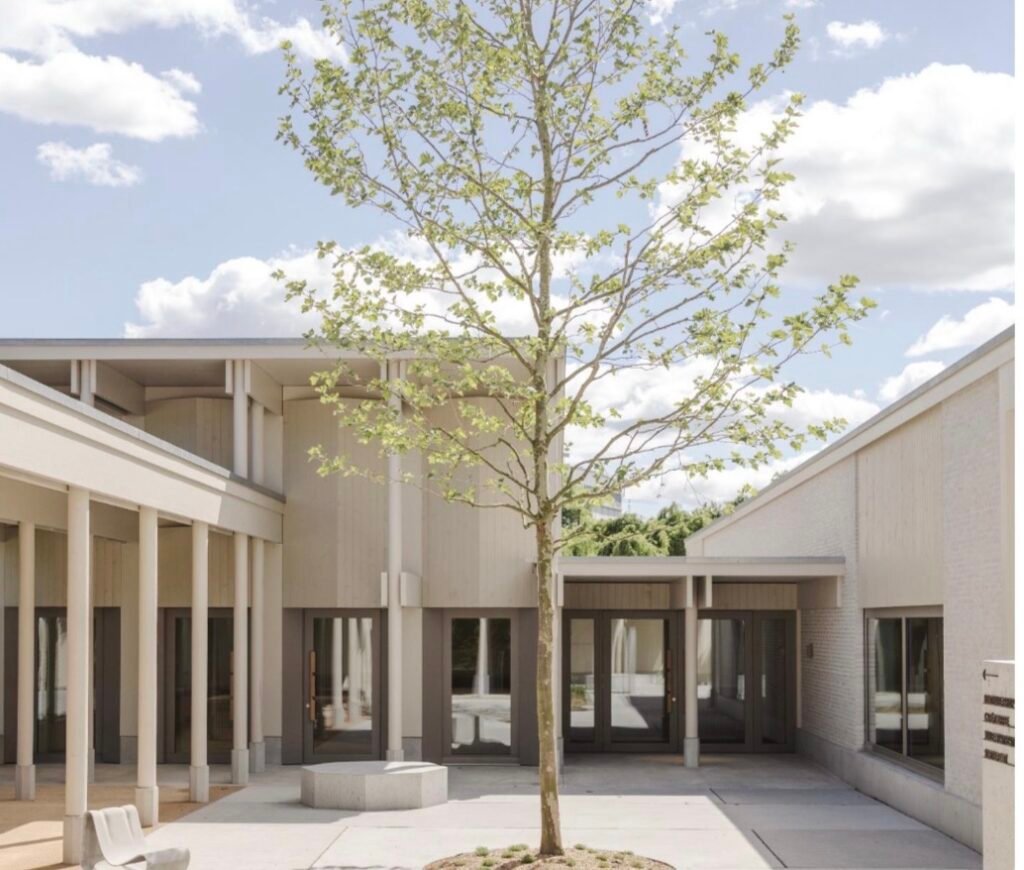
Instead of another monumental building, there is a series of pavilions integrated into the park. Trees and open spaces remain visible between them, while the central Agora is conceived more as a place for meeting and conversation than as an imposing institutional space. The architects deliberately sought to preserve the connection with the surrounding landscape and create a more open atmosphere.
There is a certain logic to this: if you want to make the world of diplomacy feel a little less distant, you might as well begin at the entrance.
First You Listen. Then You Have to Negotiate.
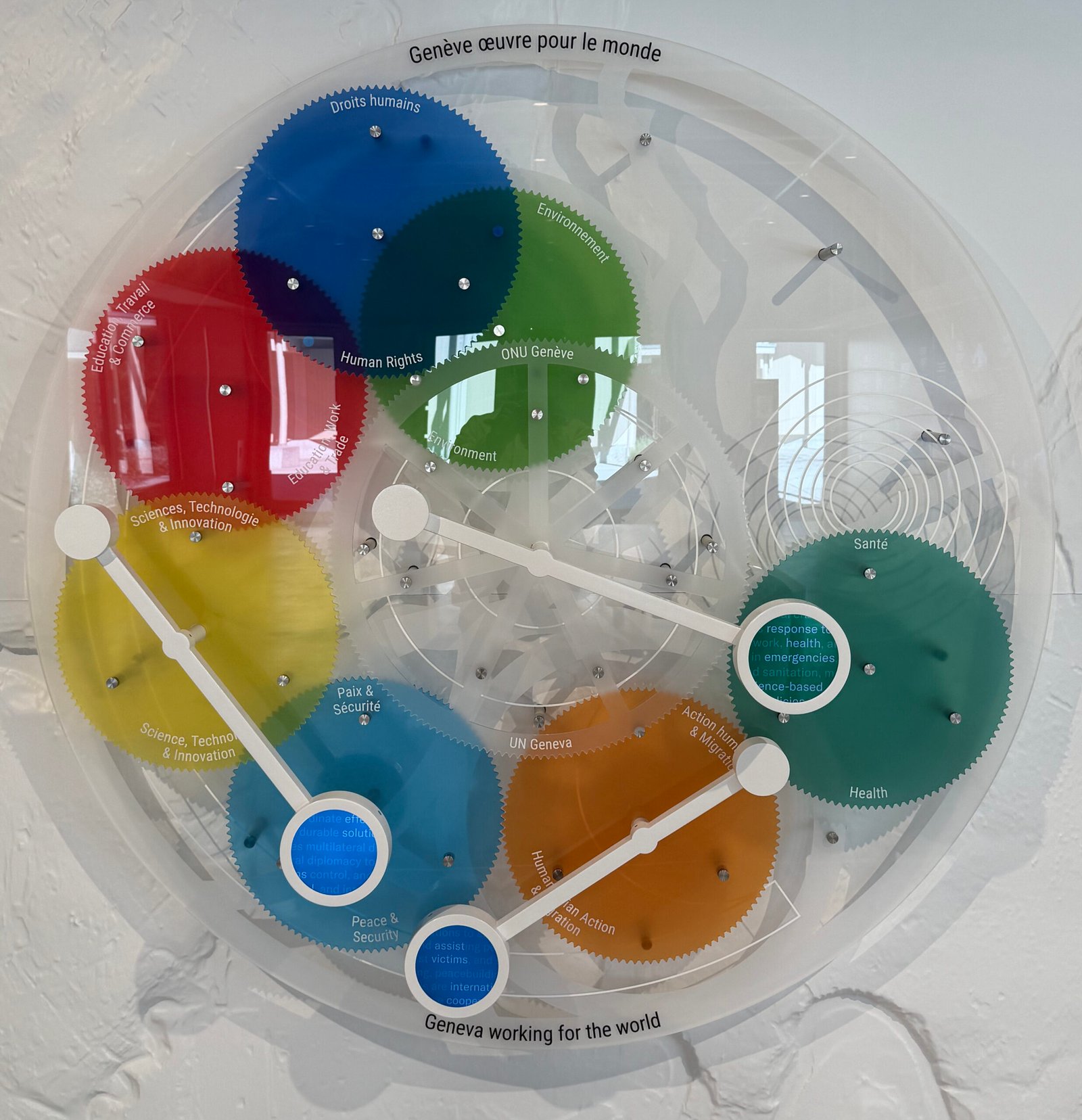
The central experience at Portail des Nations is called Together.
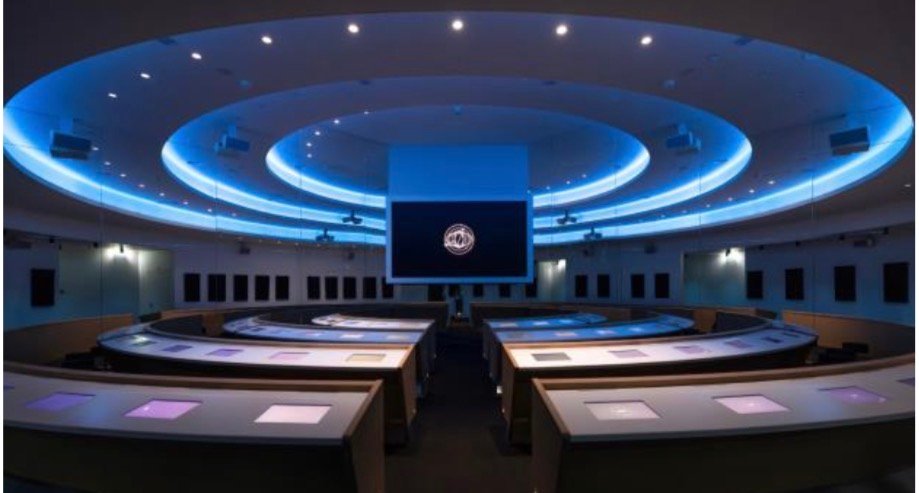
It is a one-hour immersive journey through three pavilions. This is not a conventional museum experience built around simply looking and reading. Images, sound, scenography, technology and the visitor’s own participation all play a role. Together is available in eight languages, with each session accommodating up to 40 people.
It begins with a question that sounds almost too simple: how can countries that are so different from one another manage to cooperate at all?
First comes the shared language of rights, norms, standards and principles that states develop together. Then the focus shifts to how data and expertise can be turned into collective action. One of the examples used is the Montreal Protocol.
And then the visitor’s role changes.
In the third part, watching and listening are no longer enough. Participants are asked to represent different types of countries, defend their interests, debate proposals, introduce amendments and vote on a joint resolution.
Only a few minutes earlier, I had felt almost like a student being introduced to the mechanics of the international system. Now I had to take part myself.
Of course, it is only a simulation. The world order will not be transformed by our vote.
But this is precisely where the word “compromise” stops sounding like diplomatic jargon.
As long as the task is simply to come up with a good solution, everything seems relatively straightforward. It becomes far more interesting when you have to persuade everyone else to accept it.
And then an obvious fact becomes impossible to ignore: everyone else has interests too.
Perhaps that is one of the clearest ways to demonstrate the mechanics of multilateral diplomacy. Finding a solution is not enough — you also have to make it a shared one.
A Project That Will Become Part of the UN
Portail des Nations also has a less obvious story behind it.
The project was created by the Fondation Portail des Nations in partnership with the UN Office at Geneva. Its initiator and principal donor was Ivan Pictet; it also received support from private foundations and philanthropists, as well as start-up assistance from the Swiss Confederation, the Canton and the City of Geneva.
The foundation will operate the centre until the end of 2027. From 2028, the UN Office at Geneva is expected to take over, and Portail will become the official UN visitor centre in Geneva. Its stated capacity is around 200,000 visitors a year.
It is an interesting model: a private initiative creating a space that is gradually becoming part of the official infrastructure of an international organisation.
On the Other Side of the Door
For me, the most interesting part of the visit was ultimately the change in perspective.
During my internship last year, the language, procedures and rhythms of the UN gradually became familiar. But what begins to feel natural to someone inside the organisation can appear almost impenetrable to someone outside it.
Portail des Nations genuinely helps to shorten that distance.
At some point, you stop being simply a visitor. First you feel like a student, then a participant in a negotiation, and finally an observer again — only now looking at the process a little differently.
A special thank you to the Portail des Nations team for making the visit so engaging and thoughtfully put together. Perhaps the best compliment to a project like this is a simple one: you leave wanting to know more.