Connected to the Moment: How the IMFPJ Is Rethinking Legal Education in Monaco
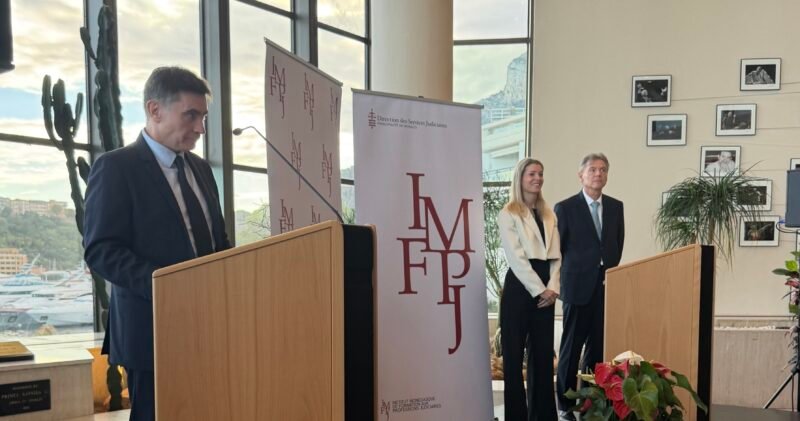
At the 2026–2027 rentrée of the Institut Monégasque de Formation aux Professions Judiciaires, Monaco set out a quietly ambitious vision for legal education — one built on technical rigour, practical experience and a close understanding of the society the law is there to serve.
To understand how a jurisdiction sees the future of its institutions, it is worth looking at how it prepares those who will one day serve them.
In Monaco, that question is taking on a new dimension.
At the fifth rentrée of the Institut Monégasque de Formation aux Professions Judiciaires (IMFPJ), the emphasis was not simply on expanding the number of courses on offer. More significantly, the evening offered a glimpse of how the Principality is thinking about the formation of its next generation of legal professionals — and about the qualities they will need in a profession increasingly shaped by changing regulation, technology and society itself.
For Yves Strickler, Scientific Director of the Institute, the starting point is an ability to remain attentive to one’s time.
“A jurist must be connected to the moment in which they live,” he told Ad Astra Journal.
Technical expertise, he explained, remains indispensable: it is at the heart of the profession. But it must be accompanied by a broader understanding of society — how it functions, how legal rules frame human activity and how lawyers themselves participate in the interpretation, application and evolution of those rules.
It is a thoughtful distinction.
And this year, that philosophy is becoming increasingly visible in the Institute’s programme.
Five years of growth
Created within Monaco’s Direction des Services Judiciaires in 2021, the Institute initially focused on preparing future magistrates and lawyers for examinations and competitive entry procedures.
Its development since then has been considerable. In 2021, six candidates were registered for the lawyer examination. At the fifth rentrée, 224 participants were enrolled in initial training, while continuing education now draws more than 900 professionals interested in legal training.
Across its programmes, the IMFPJ now records more than 1,500 registrations annually and draws on a network of more than 200 expert lecturers, including magistrates, lawyers, senior public officials, legal advisers and academics.
Speaking at the rentrée, Samuel Vuelta Simon, Monaco’s Secretary of State for Justice, described the progression as significant, noting that within five years the Institute had become the Principality’s leading centre for legal training.
Its mission has expanded alongside its audience. What began as a structure accompanying future magistrates and lawyers now also provides specialised training for practising professionals, addresses legal questions relevant to other sectors and contributes to making Monegasque law and justice better known, both within the Principality and internationally.
The Institute now sits within a wider network bringing together the judiciary, public administration, universities, educational bodies and professional organisations. Its inter-university diploma in Monegasque law has developed through partnerships with Université Côte d’Azur, Aix-Marseille Université and, from this year, Université Paris-Panthéon-Assas.
For a jurisdiction of Monaco’s scale, that proximity between institutions can be particularly valuable: expertise can be shared, professional needs identified quickly and education adapted accordingly.
From knowledge to practice
The 2026–2027 programme provides a clear example.
The annual volume of training is increasing from 60 to 100 hours, with new subjects introduced in response to requests from participants. They include construction and urban planning law, company law with a focus on litigation and competition, as well as teaching on executive, legislative and judicial power.
Strickler also pointed to taxation and property law as areas receiving greater attention this year, following demand for subjects that had previously been absent or insufficiently represented.
Yet perhaps the most interesting development concerns not what is taught, but how.
Delphine Lanzara, Executive Director of the IMFPJ, explained to Ad Astra Journal that participants had expressed a clear appetite for more practical work alongside theoretical teaching.
Sessions are therefore moving from two hours to three, with the additional hour devoted to a practical workshop in which participants can apply what they have learnt.
“Law is also theory and practice,” Lanzara said.
For candidates preparing for judicial and professional examinations, the practical emphasis goes further, with mock exams under examination conditions, individual follow-up and theatre training designed to strengthen oral performance. The logic is clear: legal expertise matters, but so do composure, judgement and the ability to argue persuasively under pressure. A new digital platform will extend that training beyond the classroom, giving participants access to course materials and online learning modules, together pointing to a more adaptable model of legal education shaped not only by what participants need to know, but by how they will be expected to use it.
“Law is everywhere”
That last point matters because the audience for legal education in Monaco is itself becoming broader.
The Institute remains closely connected to the traditional legal and judicial professions: magistrates, lawyers, notaries, bailiffs and legal advisers. Yet Lanzara described an audience extending well beyond them, including private-sector jurists, accountants, insurers and professionals in other fields whose work regularly brings them into contact with legal questions.
“Law is everywhere,” she observed.
In Monaco’s closely interconnected professional environment, the point carries particular weight.
Legal understanding does not become useful only once a dispute has reached a courtroom. It can be just as important much earlier: when making a business decision, interpreting regulatory obligations, managing an organisation or ensuring that professional responsibilities are exercised correctly.
Asked what professionals most often seek from the Institute, Lanzara gave a characteristically practical answer: a clearer understanding of how to apply the rules governing their work in practice.
“They want to avoid a lawsuit,” she said.
Legal knowledge is most useful before a dispute reaches court. Applied well, the law does more than settle conflicts; it helps prevent them.
Education as institutional capacity
The Institute’s development has implications beyond individual professional advancement.
In his address, Vuelta Simon highlighted the IMFPJ’s contribution to training professionals in the fight against money laundering. He noted that the Institute’s responsiveness and its training provision in this field had been recognised by GAFI evaluators.
For a jurisdiction with Monaco’s international profile, maintaining a high level of legal and regulatory expertise is more than an academic concern. It strengthens the ability of institutions and professionals to respond to evolving standards while preserving confidence in the systems within which they operate.
The rentrée itself reflected that broader legal ecosystem. Four dedicated spaces were presented to participants: one devoted to training, another to the legal review Monaco Droit, a third to publications on Monegasque law and a fourth centred on students and university programmes.
The review, launched a year earlier, was described during the evening as already reaching more than 10,000 readers in Monaco, France and abroad — another indication of the Institute’s ambition not only to teach Monegasque law, but to contribute to its intellectual visibility.
The same tension is evident in the courts. Francis Jullemier-Millasseau, Premier Président de la Cour d’appel, has argued that artificial intelligence may reshape legal practice, but not the human judgement on which justice ultimately depends. Listening, discernment and responsibility remain difficult to automate.
Five years after its creation, the IMFPJ therefore appears to be entering a new phase.
Its growth can be measured in participants, partnerships and teaching hours. But its more interesting evolution may be qualitative: towards an approach that combines technical precision with practical judgement, and professional specialisation with a broader understanding of society.
Which brings the conversation back to Strickler’s description of the jurist who is “connected to the moment”.
Monaco is an apt place for such an argument. Its legal professionals work within a distinctive legal tradition, but in a jurisdiction that is international, closely connected and increasingly shaped by regulatory and technological change. That makes legal education a balancing act between continuity and adaptation. Future lawyers will still need a firm command of the rules; the broader task is to ensure they also understand the economic, social and institutional world in which those rules are applied.
Interviews with Yves Strickler and Delphine Lanzara were conducted in French by Ad Astra Journal. Quotations have been translated into English for publication.