Monaco Reimagines Education
What should children learn when AI already knows the answers? Monaco’s schools are looking for an answer of their own.
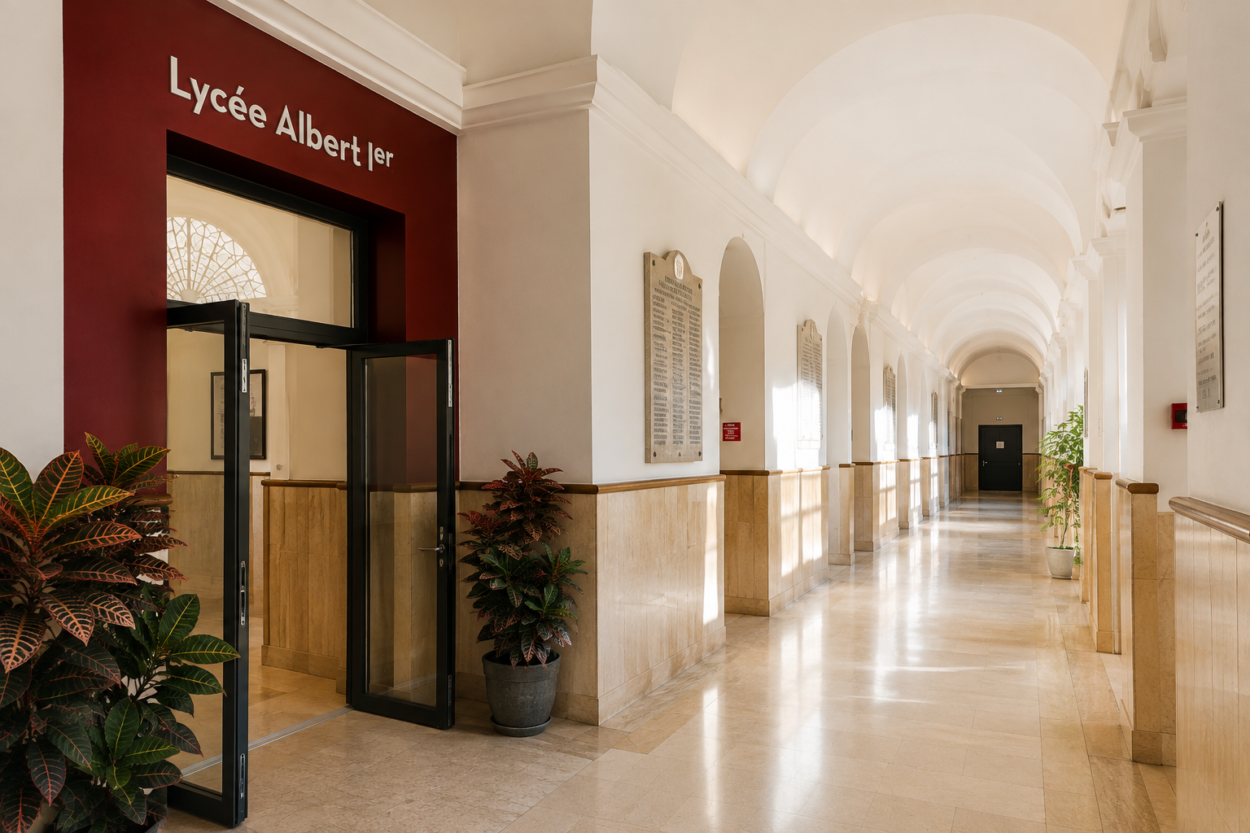
At Lycée Albert Ier, the future has arrived with an unexpected accessory: a paper textbook.
The historic school has returned to its home on the Rock after an extensive renovation. Its classrooms have been modernised for the digital age. Yet one of Monaco’s most interesting educational experiments this year involves something considerably older: putting printed books back into pupils’ hands.
This is not nostalgia. It is a choice.
As Monaco begins the 2026–27 academic year, its education policy is built around an increasingly difficult balancing act: embracing the possibilities of technology without allowing technology to determine how children learn.
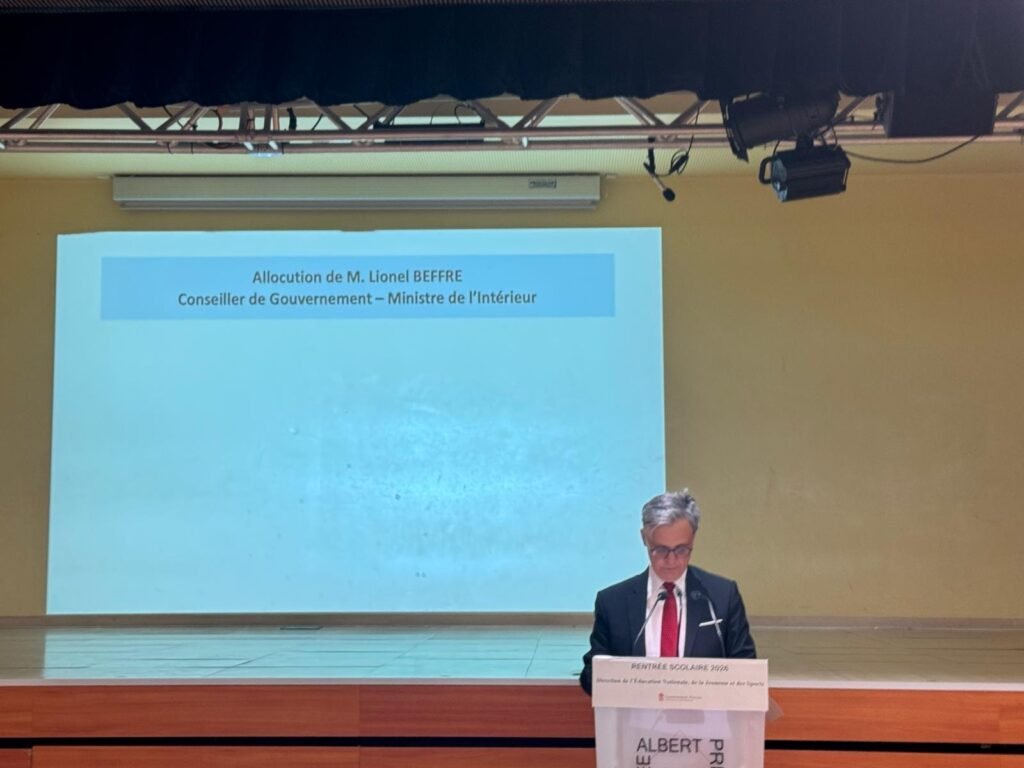
Lionel Beffre, Government Counsellor-Minister of the Interior, describes this as a search for a new equilibrium between paper and digital tools. The continuation of the NoPhone initiative is part of the same thinking: after its first year, Beffre pointed to positive effects on pupils’ attention and sociability.
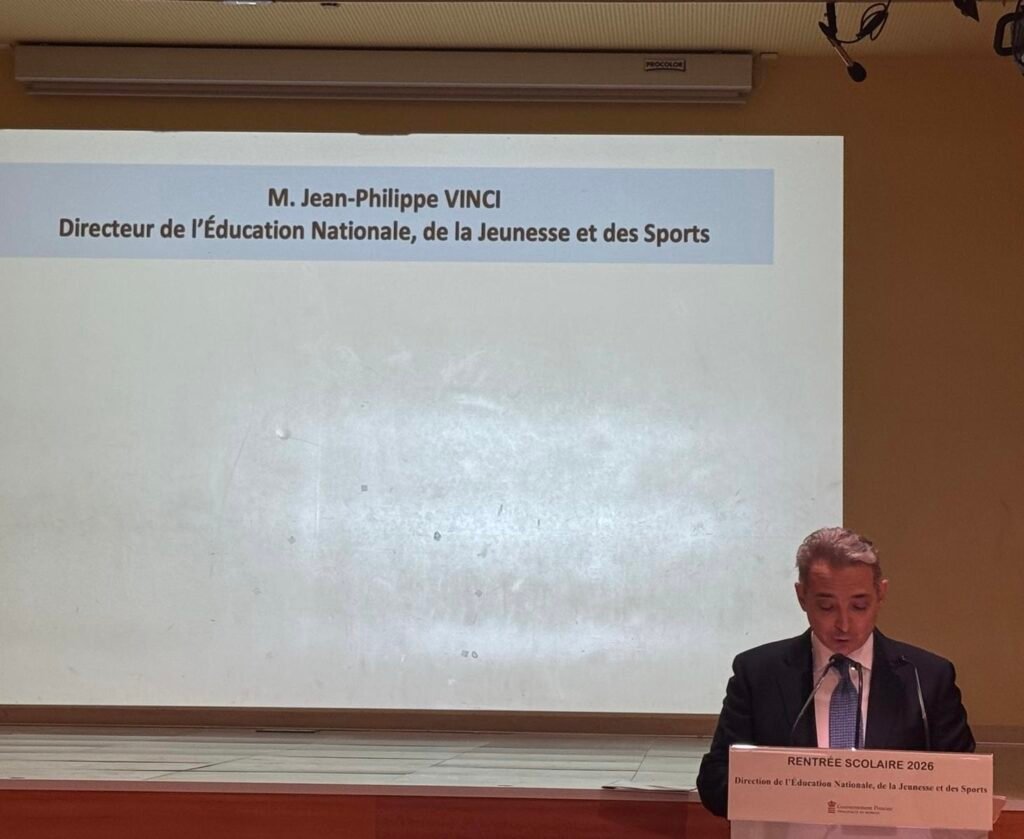
Jean-Philippe Vinci, Director of Education, Youth and Sports, goes further. He sees one of the central challenges facing schools as a “fracturing of attention”: a generation accustomed to scrolling and immediate response is being asked to master something that stubbornly takes time—knowledge.
“The construction of knowledge requires time, memorisation and, I would even dare to say, frustration.”
Jean-Philippe Vinci, Director of Education, Youth and Sports
Monaco’s answer begins with the humble textbook.
Pupils in sixième and cinquième will once again find printed books in their classrooms, alongside digital versions. Computers are not disappearing; teachers are being encouraged to choose the medium according to what actually helps pupils learn.
Vinci has a memorable description for this decidedly analogue object:
“The paper textbook is not simply a medium. It should be understood as a technology of attention.”
It is a neat inversion. Much of the digital economy has been built around technologies designed to capture attention. Monaco is experimenting with one designed to protect it.
Reading is receiving similar attention. CE2 pupils will gain an additional hour each week, while greater emphasis is being placed on vocabulary and deep reading. Vinci’s argument is that language and thought are inseparable: weaken the first and the second eventually suffers too.
And then there is AI.
Far from resisting it, Monaco is expanding training for teachers and pupils and developing more specialised applications across different subjects. The approach is deliberately dual: paper where concentration benefits from paper; AI where technology genuinely enhances learning.
The interesting question is therefore no longer whether technology belongs in education. It does. The question is whether children can learn to decide when it deserves their attention.
Intelligence beyond the machine
That question also explains Monaco’s renewed emphasis on science.
More than 300 pupils participated in the Principality’s mathematics Olympiad. For Beffre, scientific achievement is not merely about good grades: it is connected to Monaco’s future competitiveness in economies increasingly shaped by technology.
“The added value in the societies of today—and even more so tomorrow—will depend on our level in the sciences.”
For a small state, this is not merely education policy. It is economic policy with a longer horizon.
Scientific reasoning has another advantage. It teaches pupils to test a proposition rather than merely accept it—a useful habit in an online environment increasingly populated by misinformation and convincing AI-generated content. Vinci explicitly connects scientific thinking with the ability to recognise fake news.
A generation ago, the educational challenge was often finding information. Today, it is deciding which information deserves belief.
Yet Monaco’s idea of intelligence is broader than science.
Music is being expanded across final-year nursery classes following a successful pilot. The point is partly artistic, but also cognitive and social: rhythm requires concentration; playing together requires listening; learning an instrument requires repetition.
The more capable machines become, the more valuable these distinctly human abilities begin to look.
The advantage of being Monaco
Scale gives the Principality an unusual advantage.
A programme can be tested in a few classrooms, evaluated and expanded. Government, schools, cultural institutions, associations and employers are close enough to work together without the inertia of a vast national system. The system can afford to be personal.
That matters particularly when pupils begin asking what comes next.
Career guidance is being strengthened after young people themselves repeatedly raised the issue. The emphasis is moving towards more individual support and greater contact with professionals who understand the jobs and industries pupils may actually enter.
Monaco also wants education to create ambition beyond its borders without severing the connection to home. Pupils are being exposed to scientists, intellectuals and figures such as astronaut Thomas Pesquet—not because every encounter will produce a future astronaut, but because aspiration often begins with seeing what is possible.
Some of Monaco’s strongest students will inevitably leave for universities abroad. The longer game is maintaining a relationship that might one day bring their knowledge and experience back to the Principality.
Vinci describes the ambition simply: “leave, but come back.”
For Monaco, that may ultimately matter more than another percentage point in an examination table.
What not to outsource
There is a quieter side to the strategy too.
Monaco is placing greater emphasis on psychosocial skills: communication, empathy, cooperation and the ability to understand another person’s experience. These may sound like “soft skills”; in a world where machines are becoming increasingly competent at technical tasks, they may prove anything but soft.
Even discipline is being reconsidered. In suitable cases, responsibility measures can replace simple exclusion, allowing a pupil to spend supervised time with an association or community organisation. The intention is not to remove consequences but to make the consequence itself educational.
Monaco cannot know what jobs today’s pupils will be doing in 20 years, or what artificial intelligence will be capable of by then. No education system can. What it can do is prepare young people to meet that uncertainty with confidence: to use technology without becoming dependent on it, to question what appears convincing, to stay with a difficult idea long enough to understand it, and to remain curious even when an answer is only a click away.
Perhaps this is where Monaco’s educational experiment becomes most interesting. In preparing its children for an increasingly intelligent world, the Principality is not asking them to compete with the machine, but to cultivate the qualities that make intelligence distinctly human: judgement, imagination, independence of thought and the ability to give something their full attention.
When answers are instant, the real luxury is knowing what to question.